
Shawn Watson Should be on the Hot Seat
After each of his first two Offensive Coordinators left the Panthers after 1-year stints, Pat Narduzzi came into this season with some constancy at the post for the first time in his Pitt tenure. Jim Chaney and Matt Canada, his first and second guys to hold the position respectively, each left to take the same position at an SEC school. Already faced with making his third hire in three years at the position, Narduzzi was almost certainly hoping that his next hire would give him some stability at the vital position and it looks like he has some with Shawn Watson now in his second year. Despite this, steadiness hasn’t brought very positive results yet for the Panthers on offense. Coming into this season there was hope that Year 2 of the Watson Offense would yield better results due to more experience with the system and a much-hyped Quarterback in Kenny Pickett. However, last week’s debacle against Penn State shows that Shawn Watson may be ill-suited for his position and that he should be on the hot seat.
Watson Through 14 Games
To be fair, there are several caveats for Pitt’s lackluster offensive play since the beginning of last season that could serve as valid excuses. Personnel-wise, Max Browne and Ben DiNucci were simply not as talented as Nathan Peterman and the loss of two NFL-caliber Linemen not unexpectedly proved detrimental to that position group. Additionally, Watson made the decision to attempt a hybrid scheme that utilized many of Matt Canada’s concepts. In hindsight, he likely wouldn’t have implemented this type of attack that looked to be a mess at times, likely due to his inexperience running many of these concepts and the aforementioned personnel issues. Finally, he was seemingly working with a subpar Offensive Line coach that Pat Narduzzi seemed to think wasn’t developing his players to an adequate degree. With the addition of Dave Borbely to this position, who Watson had worked with before, there was hope that a more talented and cohesive unit would develop.
While Watson undoubtedly made some mistakes, it would be ridiculous to attribute Pitt’s entire drop-off in offensive production from 2016 to Watson’s performance due to these reasons. After all, that was a historic offense that featured many vital upper-classmen, including 4 players that were selected in the next year’s NFL draft. However, the decline was incredibly swift and steep. Pitt went from scoring nearly 5 Touchdowns on offense per game to less than 3 and the average yards per play went down over a yard and a half.
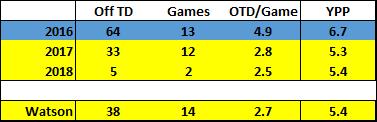
As mentioned earlier, there was hope that Watson would have the Panthers rolling out a more effective attack for a variety of reasons. After all, he had led some potent offenses while Offensive Coordinator at Louisville during the early part of the decade, though that team had an excellent Quarterback in Teddy Bridgewater. However, as the above stats indicate, through a small sample size things seem to be more of the same for the Panthers. Of course, two games do not make a season, but it’s troubling that things don’t look much better through these early games.
What specific issues does there appear to be with how Watson runs the offense? Generally, there are two major things that we see on gameday that many other fans will have certainly also noticed. Primarily, that is play-calling and the lack of adjustments. The former is often a convenient and easy scapegoat by fans whenever there are offensive woes. Despite this, Watson’s choices have been truly head-scratching at times and, though there are many examples, I’ll go over three that stick in my mind from Watson’s brief tenure.
Play-Calling Woes
The first occurred during Homecoming last year against the North Carolina State Wolfpack. With Pitt down 28-17 late in the 4th quarter, the Panthers were driving down the field to try to keep their hopes alive. Facing a 4th & 10 from the NC State 42, with the game on the line, Shawn Watson decided it would be a good time to for an option run play. Though this type of play can go for large gains, it is typically utilized as part of a scheme revolving around it, designed to methodically gain field position and dominate time of possession. Most well-run option plays still fail to gain 10 yards and there’s a reason that teams that actually run this scheme still typically throw on 3rd/4th down and long. Also, these are teams that are experienced running these plays, which Pitt most certainly is not. Frankly, it was a ridiculous play-call given the circumstance.
The next example occurred several weeks later against Virginia Tech. Despite being down 20-14, the Panthers found themselves in a fairly enviable position, having a 1st & Goal from the 1-yard line. The ensuing play sequence went as follows: Darrin Hall rush for no gain, Darrin Hall Rush for No Gain, Timeout, Incomplete pass attempt to Jester Weah, Darrin Hall rush for a loss of 3 yards. The first two rushes were power rushes that, in theory, should’ve done the job if the Offensive Line got enough push. However, the Line had been manhandled all day so a little more creativity earlier may have been called for, at least after it failed on 1st down. The passing play that Watson called on 3rd down, being a quick throw to Jester Weah in the back corner of the end zone, seemed to only have one option. Virginia Tech knew it was coming and had it well-covered. The 4th down call was the most egregious though, as it was a slow-developing halfback draw that resulted in a loss. With it being well-documented to this point that the offensive line was struggling, I’m not sure what made Watson think they could block well-enough against a strong Virginia Tech Defense that had stacked the box to allow this play to succeed.
Finally, just last week against Penn State, Pitt found themselves deep in Penn State territory in the 1st half with the chance to take the lead. Down 7-6 and facing 4th & 3 from the Nittany Lion’s 4 yard-line, the Panthers decided not to kick a Field Goal in the driving rain. Watson seemingly called for an inside run, but Narduzzi called a timeout after not liking the matchup. Out of the timeout, Pitt came out in a different formation, but still ran an inside run to Qadree Ollison. Penn State, much like Virginia Tech last year, blew up the play almost right away and dropped Ollison for a loss of 3 yards (again). We all know what happened next.
These three examples seem to illustrate Shawn Watson’s overall play-calling philosophy. It is unintelligent, unimaginative, and stubborn. The NC State example shows the unintelligence, as any competent play-caller should not be running an option run on a do or die 4th & long when your team has never run it and has seemingly never practiced it. The Virginia Tech sequence shows how it is unimaginative as, despite needing only 1 yard, Watson called a boring predictable sequence that resulted in a net loss of 3 yards. Finally, the Penn State play-call shows his stubbornness, in that in a similar situation, he called a similar play that had an identical result.
Lack of Adjustments
This brings up the other issue with Watson’s gameday coaching, his seeming inability to make adjustments. This was observed on a micro and macro level during the Penn State game. The aforementioned sequence of giving a look, calling a timeout, and then running a near-identical play shows this at the micro level. At the macro level we see that he seemingly made no changes to his game plan at halftime as well.
Given the weather conditions last weekend, Pitt was actually moving the ball okay. Qadree Ollison in particular was having a nice day, with 125 rushing yards and a Touchdown through the first half. However, he actually had a net negative rushing total in the 2nd half and finished the day with 119 yards. The rest of the offense was similarly ineffective, though to be fair they spent much of the half backed up by their own goal line due to poor special teams play. However, in his brief time here, the Panthers under Shawn Watson have made a habit of underperforming in the 2nd half relative to the 1st half.
It should be expected that scoring between halves should be somewhat similar over larger sample sizes. One may even expect the 2nd half to be slightly higher due to more tired defenses and teams trailing attempting come-backs. However, that hasn’t been the case for Pitt since the beginning of last season. Over these 14 games, the 1st half has been their higher scoring half 9 times compared with only 4 times where that’s been the case for the 2nd half (there was one game that had the same total in each half). Additionally, over the same span, Pitt has scored on average a touchdown less in the 2nd half compared with the 1st half (1st half average of 14.9 points compared with 2nd half average of 7.9 points). While this doesn’t directly show that there have been limited and/or ineffective adjustments made over the course of each game to Pitt’s offensive gameplans, it is a good proxy measure given that we aren’t on the Pitt sideline during the games.
Time for the Hot Seat
There are somewhat legitimate excuses for Pitt’s offensive woes under Shawn Watson. I’ve already gone over the ones that apply to last year. For this year, you can make the excuse of Pitt not opening up the playbook against Albany and the weather affecting things last week against Penn State. However, as I’ve shown, many of the same base issues of questionable play-calling and lack of adjustments are still present. The fact is, at this point Watson is running out of excuses for his offenses not scoring. The next couple games will be telling as Pitt faces a couple of opponents in Georgia Tech and North Carolina that have proven to be pretty weak on defense. If Pitt is unable to move the ball well against these opponents, even if they come away with wins, then it will show that Watson hasn’t really learned anything from his first 14 games at Pitt. Unfortunately, I wouldn’t count on him to magically learn anything despite the debacle against PSU, as many of the points mentioned above seem to be common complaints about him. I’m not calling for Pitt to fire Watson, as he has shown that he can have success. However, he should be officially on the hot seat (not that this is an official designation given to coaches) and how the offense does the remainder of the season should determine his long-term future with Pitt. Certainly, if the next 10 games look like the past 14 games have offensively, he should not be back in 2019.
* Stats courtesy of College Football Reference and ESPN.com
Think Watson should have a longer leash? Or should he be let go now? Let us know in the comments, on the message board or over Twitter @IntoPitt and @TheJeemTeam