Will Pitt’s Offense Improve on Dismal 2019?
After a tumultuous offseason that had nothing to do with football, the Pitt Panthers begin their 2020 season this weekend against Austin Peay out of Clarksville, Tennessee. Realistically, we should all just be grateful that we even get Pitt football this Fall, unlike a certain in-state rival. We should all also be hoping that the season is able to be played relatively safely for the players, staff, and other football operations personnel. There will also be an ever-present looming specter of postponements, outbreaks, players opting out, and of the season not even being completed. All of these factors that should be at the forefront of our minds as we begin a college football season unlike any other in living memory. However, at the end of the day we’re all Pitt fans. Regardless of what else is going on, it’s natural to want the Panthers to go out and win as many games as possible. In service of that, there’s no shame in wondering, is the offense going to be any better this season? College football can be very unpredictable. This will particularly be the case this season. However, there are several factors that point to a high probability of at least a modest increase in offensive production.
For as good as Pitt’s defense was last year, it’s offense was just as bad. If not worse. Though Kenny Pickett had over 3,000 yards passing (3,098) that number was mostly due to the pass-heavy offense utilized. That reveals itself when looking at Pickett’s pedestrian 6.6 yards per attempt figure. Among 101 qualified passers in the country (14 attempts/game, 75% of school games played), that ranks 87th. For the offense as a whole, Pitt had 380.9 yards per game and 5.2 yards per play. Those stats rank 87th and 102nd out of the 130 FBS teams. Unsurprisingly, the run game was even more anemic with 119.2 rushing yards per game (118th) and 3.5 rushing yards per play (119th). At the end of the day all that matters is how much the Panthers scored. Unfortunately there’s little good news in that area as Pitt’s 21.2 points per game ranked 113th in the country.
The good news is that there’s not much room for the Pitt offense to go down even further from the moribund performances of 2019. However Pitt can’t lean on their defense as they did last year if they expect to take a step forward. Especially given the more difficult 10-game conference schedule and the elimination of divisions for this season. Pitt will need a sizable offensive improvement if they are to have a chance at finishing in the Top 2 of the ACC. Luckily an increase in offensive production can be expected based on stability at Quarterback and Offensive Coordinator, stability throughout the whole offense, and a likely regression in factors that Pitt was unlucky in last year (Drops, Turnovers, Penalties). When you consider all of these facts, you can see why I’m bullish on the Pitt offense to see at least some improvement this season.
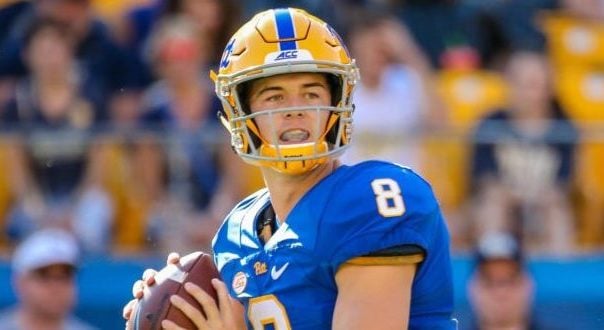
Let’s take a look at the consistency at Quarterback and Offensive Coordinator. Though football is obviously a team game in every sense of the word, these are the two most visible individuals that impact the offense. Pitt is in a somewhat rare position in the college game where they have the Offensive Coordinator and the primary starter from the previous season both returning. Over the past 10 seasons, there have been 650 individual team seasons among the current Power 5 teams. That number is reached by multiplying the 65 Power 5 teams plus Notre Dame by the 10 seasons each had during the 2010’s. Having the same Offensive Coordinator/Quarterback tandem has only happened 52 times, or 8% of the time, by my count. Additionally, Pitt has never had a team included in those 52 instances. You have to go all the way back to 2006 when Pitt was in this situation. That year they had the same setup as the current outfit, with a Senior Quarterback entering his 3rd season as the primary starter and an Offensive Coordinator beginning his second season. That year Tyler Palko and Matt Cavanaugh led a potent Panther offense that scored 31.8 points per game, ranking 14th in the country.
Looking at the more recent examples, I ran the numbers from the 52 teams in the 2010’s. Overall, there’s actually a pretty weak correlation between having this stability and seeing an increase in offensive performance. However, that’s not unexpected as there’s so much more that goes into how good an offense is than having stability for just two individuals. However, there was generally a modest increase in important offensive statistics. On average, for these teams, the Quarterback’s completion percentage went up 2.2%, yards per attempt went up 0.4, and passer rating went up 7.8. The total team offense Yards per play went up 0.3 and the teams scored 2.2 points per game more. The chart below shows what stats Kenny Pickett and the Pitt offense will have this year if they hit these average increases exactly.
[table id=25 /]
It’s apparent that these are modest increases and should maybe serve to temper expectations just a bit. However, as I just said, there’s more to offensive productivity than two people. The points below show why I still think Pitt could be in for a big uptick on offense.
Pitt does not just have stability at Quarterback and Offensive Coordinator. Overall, of the 11 players listed as offensive starters on the Quick Lane Bowl 2 Deep, 8 of them are listed as starters on this week’s 2 Deep. Not only that, but 4 of the 5 starting offensive linemen are returning. Other than maybe Quarterback, this is the position group that is most important to have stability.
[table id=26 /]
Wide Receiver Maurice Ffrench, Tight End Nakia Griffin-Stewart, and Right Tackle Nolan Ulizio are the 3 starters that are being replaced. Of these, Maurice Ffrench is by far the one that will likely be missed the most. However, he is being replaced by intriguing true Freshman Jordan Addison who is already getting buzz as a potential ACC Offensive Rookie of the Year. Nakia Griffin-Stewart was a serviceable Tight End who had too many drops for my liking. His replacement is Lucas Krull. The former Florida Gator arrived at Pitt the same way all Tight Ends seem to, via a grad transfer. Krull found himself behind superstar Tight End Kyle Pitts on Florida’s depth chart, hence his decision to transfer. Finally, the lone Offensive Lineman leaving also happens to be one that I’m not exactly sad to see leave. Nolan Ulizio was a terrible Right Tackle in his lone season as a Panther. When he wasn’t getting called for False Starts, he was being manhandled by opposing Defensive Ends and Outside Linebackers. Gabe Houy slides over from the Right Guard position to take over that spot. It will be very hard for him to be less proficient than Ulizio was there. Taking Houy’s spot at Right Guard will be Jake Kradel, who split time with Houy last year at Right Guard.
Even beyond the starters, the Panthers have a great deal of experience on offense this season. Though A.J. Davis is listed as the starter, Vincent Davis and Todd Sibley all had significant playing time last year and figure to contribute again this season. At receiver Tre Tipton is back after being granted a 6th year of eligibility and Jared Wayne showed flashes in the second half of the season, setting up what could be a breakout campaign for the Sophomore. Juniors Owen Drexel and Carson Van Lynn and grad transfer Keldrick Wilson provide experience beyond the starters on the Offensive Line. Overall, this is a much more battle-tested and experienced group than last year. Which brings us to the final point.
Though we’ve already shown that last year’s Pitt offense left much to be desired, it’s worth mentioning that it also seemed like nothing ever went their way. On average they committed nearly 2 turnovers per game (1.7), which was 94th in the country. Additionally, they committed nearly 8 penalties per game (7.8), which was the 10th most in FBS. Granted many of those penalties came on defense, but it seemed like every other drive was getting stalled by a boneheaded procedural penalty, such as a False Start, Illegal Formation, or Delay of Game. Precise penalty statistics are hard to come by, but I’d find it hard to believe that anyone who watched this team last year wouldn’t agree with me. Another figure that’s hard to find is dropped passes. Once again though, anyone who watched Pitt last year will agree that the Panthers seemed to suffer in this department at a much higher rate. The one stat I was able to find was Pro Football Focus stating that his receivers dropped 36 passes last season. This works out to almost 3 dropped passes per game (2.77). I don’t know how that compares to other Quarterbacks, but the implication from PFF is that it was unusually high.
All of these are issues that stem from discipline and luck. It’s reasonable to expect the procedural penalties to go down with more experienced linemen. The same is true for dropped passes. I don’t know if it’s possible for the receivers to drop passes at a higher rate than they did last season. One would also expect luck to, if not turn around, to at least even out in the turnover department. No one seems to like to admit it, but luck plays a large role in turnovers. With Pitt coughing up the ball at a higher than normal rate last season, some regression to the mean should be expected. It’s simple. With less turnovers, drops and procedural penalties, less drives will stall out and Pitt will score more points and hopefully win more games.
All of these by themselves would not be enough to expect an offensive renaissance for Pitt football in 2020. However, when you combine stability from the two most important individuals, general stability across the offense, and expected regression in discipline and luck factors, it would be a massive disappointment if there isn’t some noticeable improvement to the offense. At the same time, I caution Pitt fans to not expect an outlier type performance. Of the 52 teams I mentioned above only 5 teams scored more than 10 points per game more than the year previously. The most extreme outlier was last year’s National Champion LSU, who were in the 2nd season of the Joe Burrow/Steve Ensminger combo and improved by 16 points per game. Frankly, it would be foolish to expect Kenny Pickett to be the next Joe Burrow. However, there’s a large chunk of teams that improved their points per game by 5-10 points (12 teams). Given the other intangibles mentioned in this piece, it may not be outside the realm of possibility to expect an increase of this magnitude. Combined with the shutdown defense, that may be enough to make some noise in a 15-team no-division ACC.
*Stats courtesy of College Football Reference
Give us your thoughts on Pitt’s offense going into 2020 by commenting below, posting on the message board or talking to us on twitter.