Pitt in the ACC: A Look Back at the First Five Years
Pitt officially joined the Atlantic Coast Conference in all sports on July 1, 2013, five years ago last month. Shortly after that the football team played their first game as a member, a nationally televised Labor Day night game against Florida State. The move had been long-anticipated, with the initial announcement coming in 2011 and rumors of Pitt leaving the decrepit Big East for several years prior. The expectancy was palpable that night at Heinz Field with a sellout crowd on hand and a pregame celebration of Pitt’s new conference home. The team even briefly rewarded and enhanced the celebration by scoring on the opening drive of the game to take an early 7-0 lead. It wasn’t to last though as the eventual national champions quickly took control of the game and ultimately won 41-13. The game was a quick reality check. After the built-up excitement over Pitt finally finding a stable home for athletics, when the time finally came they still had to go out and play the games. I would almost compare it to a marriage. The engagement happened in 2011 when the move was first announced and what followed was a 2-year period of planning and anticipation. The wedding itself happened on Labor Day 2013 and everyone had a great party to celebrate. Unfortunately, there was no honeymoon and after the “wedding” all that’s left is the actually living with each other. Extending this metaphor further, one could say that Pitt is now at the 5th anniversary of its marriage with the ACC. How have the first 5 years gone for Pitt? Where do they fit in the conference hierarchy? How does the future look? These are the questions I look to answer as I go through the first 5 years of Pitt in the ACC.
A Timeline of Pitt’s First 5 Years in the ACC
As a disclaimer, I will only be looking at Pitt football’s first 5 years in the ACC. There is plenty worth mentioning that has happened in the other sports, but the focus here will be on the football team. With that out of the way, let’s start with a brief timeline of Pitt football in the ACC:
- September 18, 2011 – The ACC Council of Presidents vote unanimously to accept Pitt (and Syracuse) as the 13th and 14th members of the conference.
- July 1, 2013 – After playing out two lame duck seasons in the Big East, Pitt officially joins the ACC.
- September 2, 2013 – Pitt plays their first game as a member of the ACC, a national broadcast on Labor Day against Florida State. Though Pitt jumps out to a 7-0 lead, they eventually fall 41-13 to the Seminoles.
- September 21, 2013 – Pitt wins their first ACC conference game, a 58-55 barn burner against Duke in Durham, North Carolina. Myself, and I’m sure many other Pitt fans, were introduced to the awfulness that is ACC Network broadcasts.
- November 29, 2013 – Pitt wraps up their first regular season in the ACC with a 41-31 loss to the Miami Hurricanes. They go 6-6 overall and 3-5 in ACC play. They receive an invite to the Little Caesar’s Pizza Bowl in Detroit where they would clinch a winning season with a win over Bowling Green State.
- October 25, 2014 – Pitt reintroduces the popular “Pitt script” on the football helmets the day before the homecoming game against Georgia Tech. Though there is initial excitement, the rushed, unorganized, and seemingly random nature of the rollout comes off as almost desperate by the Athletic Department leadership. Pitt is subsequently embarrassed by the Yellow Jackets, fumbling the ball 5 times in the 1st quarter and falling behind 28-0. They would fumble once more and eventually lose 56-28.
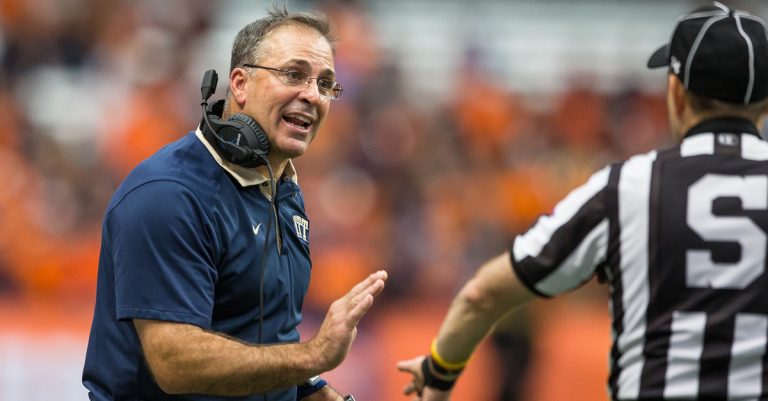
- November 1, 2014 – Pitt loses to Duke 51-48 in double overtime after Chris Blewitt misses a potential 26-yard game winning Field Goal at the end of regulation. Head Coach Paul Chyrst is deservedly criticized for not “centering” the ball when given the chance and forcing Blewitt to make the attempt from a tough angle.
- November 29, 2014 – Pitt beats Miami 35-23 to reach 6 wins and bowl eligibility in the last game of the season. They finish 6-6 overall and go 4-4 in ACC play.
- December 17, 2014 – After a week of speculation, Pitt coach Paul Chryst is introduced as the new Head Coach of Wisconsin, his alma mater. Almost simultaneously it was announced that Steve Pederson had been fired as Pitt’s Athletic Director.
- December 26, 2014 – Michigan State Defensive Coordinator Pat Narduzzi is introduced as Pitt’s new Head Coach.
- January 2, 2015 – Pitt completes a whirlwind holiday season by blowing a 31-6 4th quarter lead to the Houston Cougars in the Armed Forces Bowl. Houston would win 35-34 after scoring 3 touchdowns while recovering 2 onside kicks in the final 3:41.
- October 17, 2015 – Chris Blewitt converts a game winning 56-yard Field Goal to beat Georgia Tech. The win runs Pitt’s record to 5-1 (3-0) and Pitt subsequently enters the AP Poll (#25) for the first time since 2010.
- October 24, 2015 – Pitt beats Syracuse 23-20 to move to 6-1 (4-0) on the season. The win is thanks in large part to a gutsy fake punt during the game winning Field Goal drive. Pitt moves to #23 in the AP Poll. They would fall out of the poll and not return that season after losing their next game against UNC though.
- November 27, 2015 – Pitt loses to Miami 29-24 in the regular season finale but completes their best ACC season to date by going 6-2 in conference play.
- December 28, 2015 – Quadree Henderson returns the game’s opening kickoff for a touchdown, but Pitt would eventually fall 44-28 to Navy in the Military Bowl.
- May 18, 2016 – Pitt completes their transition from the “Block Pitt” logo they used for the majority of the 2000’s back to the classic “Script Pitt” logo with an unveiling of their new uniforms at an event at the Petersen Events Center.
- September 3, 2016 – James Conner makes his triumphant return in the season opener against Villanova after missing almost the entire previous season due to a torn MCL in his right knee and subsequent cancer diagnosis. He scores two touchdowns in Pitt’s 28-7 win
- September 10, 2016 – After a 16-year hiatus, Pitt renews their rivalry with Penn State. The Panthers win 42-39 with Ryan Lewis sealing the game with an interception in the Panther’s endzone late as Penn State attempted to drive for a game-tying or go-ahead score.
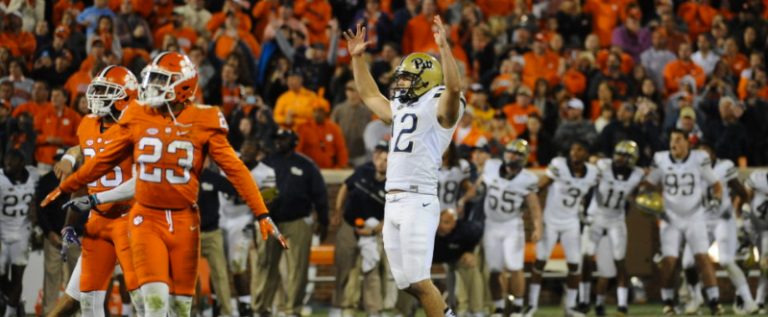
- November 12, 2016 – Pitt pulls off a shocking upset by going into Death Valley and beating the #2 ranked Clemson Tigers 43-42. Chris Blewitt won it with a 48-yard Field Goal with 6 seconds remaining, more than making up for a missed extra point earlier in the game.
- November 26, 2016 – Pitt ends the regular season with a wild 76-61 win over Syracuse. The 137 points scored are an FBS record. The win gives Pitt a 5-3 record in conference play.
- December 22, 2016 – It is announced that Pitt Athletic Director Scott Barnes is leaving Pitt for the same position at Oregon State. His Pitt legacy will primarily be associated with his Men’s Basketball Coach hire though.
- December 28, 2016 – Pitt ends the season in disappointing fashion in an upset loss to Northwestern in the Pinstripe Bowl. The game represents the last in a Pitt uniform for James Conner and Quarterback Nathan Peterman. Offensive Coordinator Matt Canada, the mad genius behind Pitt’s historic offensive output from the 2016 season, also leaves the program for the same position with LSU.
- March 20, 2017 – Pitt hires Heather Lyke to replace Scott Barnes as Pitt Athletic Director. She is the first female Athletic Director in the school’s history.
- October 7, 2017 – Pitt loses to Syracuse 27-24. It’s only the 3rd time since 2001 and the first time since both schools joined the ACC that the Panthers lose to the Orange. Starting quarterback Max Browne suffers a season-ending injury and Pitt falls to 2-4 (0-2) on the season.
- November 9, 2017 – Pitt loses 34-31 to UNC in a nationally televised Thursday night game to fall to 4-6 (2-4) on the season. UNC came into the game with a 1-8 record and would be the only conference game that the Tar Heels would win during the season. UNC remains the only ACC Coastal team that Pitt has failed to beat since joining the conference.
- November 18, 2017 – Ben DiNucci is replaced at Quarterback by Kenny Pickett after throwing an interception late in the 1st Quarter. Pickett almost leads an upset over the Hokies, but the Panthers fail to score a TD late despite having 1st & Goal from the 1-yard line. Virginia Tech holds on 20-14 and the Panthers fall to 4-7 (2-5).
- November 24, 2017 – In his first career start at Quarterback, Kenny Pickett leads an improbable upset over the undefeated and #2 ranked Miami Hurricanes. The Panthers still finish 5-7 (3-5) and miss out on a bowl for the first time since 2007.
- December 6, 2017 – Despite the losing season, Heather Lyke announces a 7-year extension for Pat Narduzzi through 2024.
- August 3, 2018 – Pitt begins training camp in preparation of a pivotal 2018 season, the school’s 6th in the ACC and the 4th of Pat Narduzzi’s tenure.
How Does Pitt Compare with the Rest of the Conference?
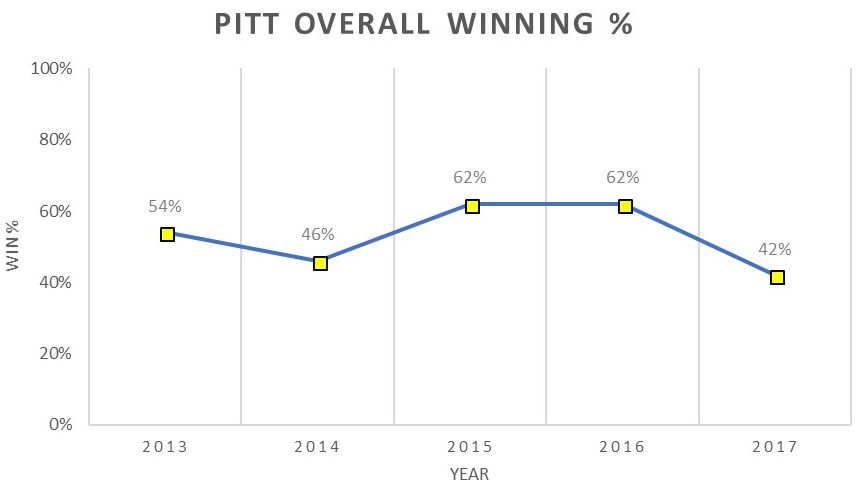
As the timeline shows, Pitt football has had some high highs and low lows over the past 5 seasons. The records bear out these mixed results. They’re 33-30 overall and 21-19 in ACC play since joining the conference. Looking at it year-by-year shows that they’ve overall had middling results, with their record a result of consistent medium performances and not wild changes in fortune over the past five years.
[table id=5 /]
[table id=6 /]
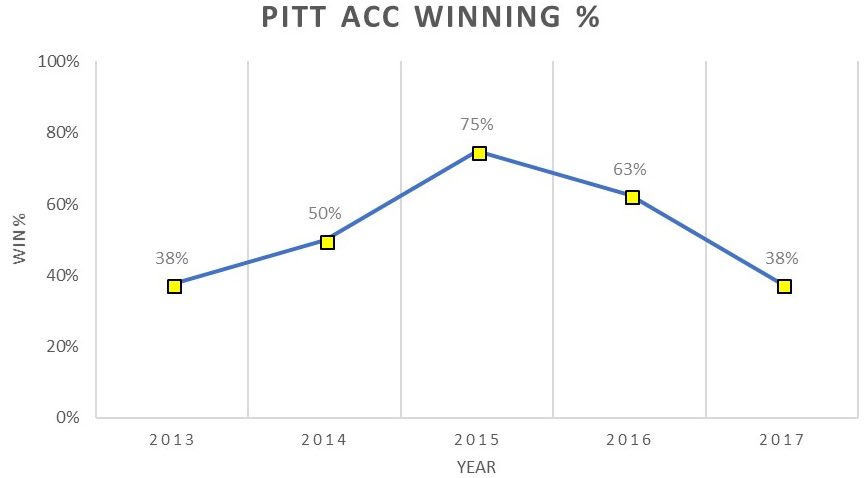
As you can see, there was a spike winning percentage in conference play in 2015, but the small sample size means it was only the best mark by 1 game. Additionally, I’d bet that most Pitt fans, myself included, would say that the 2016 team was better than that season’s group. Regardless, these charts all paint a picture of mediocrity. They show a Pitt that is consistently able to stay out of the basement, but not able to break into the next level.
Despite the mediocrity, how has Pitt stacked up against the rest of the ACC? There was definitely a concern prior to Pitt officially joining the conference that they would not be able to compete given the step up in competition, especially given the relative turmoil surrounding the program around when they came aboard. Unsurprisingly, Pitt has not been in the upper echelon of the conference, but they also haven’t been in the basement.
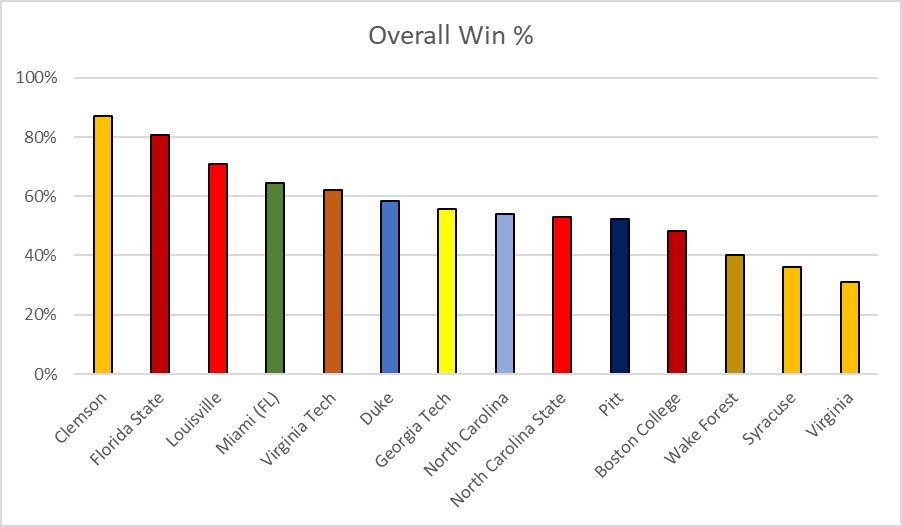
This chart and the one below don’t include Maryland, who was still a member of the ACC during the 2013 season. Rather I’m just pretending that Louisville, who basically replaced them by joining in 2014, were members that year despite playing in the American Athletic Conference that year.
As seen in this chart, Pitt is only 9 out of 14 teams in the conference in overall winning percentage since joining the league. However, they are only slightly behind the teams immediately ahead of them and given the separation between them and the “bottom-feeders” of the conference they can be said to be in the middle of the pack. Their position slightly beneath the rest of the middle pack can probably be explained by their tougher than average non-conference schedule over the last five seasons and poor bowl record (1-3 since joining the ACC). This hypothesis is supported by them fairing better when you only look at each ACC team’s conference record during the same period:
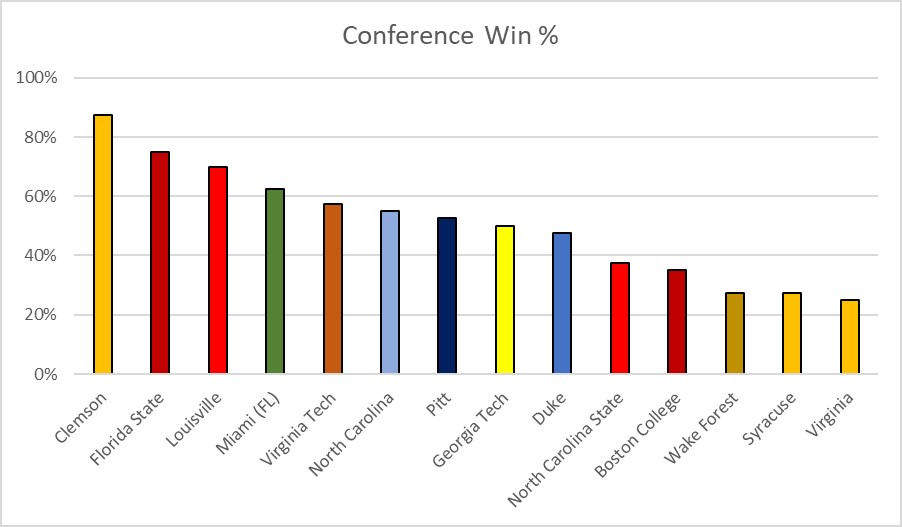
This chart is probably a better reflection of Pitt’s place in the ACC hierarchy since joining. It makes sense that only comparing games against fellow ACC teams are more indicative of where the team stands given how that Pitt hasn’t been able to rack up as many wins against cupcake opponents as other teams. When looking at only conference games, Pitt moves up two spots to 7 out of 14 teams.
Though this position is slightly better and maybe more indicative in their place in the conference, they’re still squarely in the middle class. This reiterates a major theme of Pitt’s first 5 seasons in the league, and that is one of overall mediocrity. Pitt has been bowling 4 out of their first 5 years, but never in a premier game. The best they’ve ever done was an appearance in the Pinstripe Bowl after the 2016 season. This was the only ACC Tier One Bowl they’ve been selected for and they have never come close to getting selected for New Year’s Six Bowl. They’ve also never really come close to winning the Coastal Division and appearing in the ACC Title Game. The best they’ve done were 2nd place finishes in 2015 and 2016. However, in 2015 they finished a full two games behind Coastal champion UNC who went undefeated in ACC play and the next year they were part of 3-team logjam with Miami and UNC behind Virginia Tech.
Though Pitt fans have to be getting frustrated with failing to break into the upper echelons of the conference, they have still been going to bowls and have avoided the basement. In that respect, they’ve been more successful than Syracuse, who entered the conference with them in 2013. The Orange have only gone to one bowl since then and have regularly finished towards the bottom of the Atlantic division. Additionally, Syracuse’s overall and conference records over this period are 13th out of the 14 teams. Also, Pitt has had more success than longtime ACC members Virginia, Wake Forest, and Boston College. While these platitudes may be comforting to some, the Pitt faithful should expect more and aren’t satisfied with hoping to receive an invite to the QuickLane Bowl.
It is also important to note that the Pitt football program was a mess as a result of the coaching debacles and general mismanagement by the Athletic Department following Dave Wannstedt’s ouster in 2010. In addition to general instability this led to poor recruiting, the effects of which are felt for years down the road. This is how ended up with the atrocious defensive performances we’ve generally seen through the first three years of Narduzzi’s regime. Given the chaos surrounding the program it’s almost a miracle that Pitt was invited to a bowl every year since 2008, though admittedly they usually barely qualified. Because of this, I think people often forget the difficulties facing Pitt when they joined the ACC, which I mentioned above. When viewed through this lens, it’s actually kind of impressive how they’ve managed to hold their own in the conference.
Outlook of the Next 5 Years
What do the next five years and beyond hold for Pitt? No one can predict the future, but what I can say is that mediocrity year in and year out is not going to cut it for much longer. While it may not be feasible to ever expect a return to the heyday of the late 1970’s and early 1980’s, I don’t think it’s unreasonable to expect them to consistently finish near the top of the Coastal division and make a serious run at winning the ACC every few years. Despite holding their own while the program has been slightly chaotic, we’re getting past the time where “holding their own” is acceptable.
Despite the time coming soon where Pitt needs to start producing, I think this year they get a pass on needing to make too much noise given the difficult schedule, questions at Offensive Line, and breaking in a new quarterback (despite how hyped he may be). Starting in 2019 though, Pitt needs to start competing regularly for a division title. Though the rest of the Coastal is getting better, Pitt aspires to be at a level above Duke, Georgia Tech, and Virginia. There’s no reason for Pitt not to win the Coastal at least once before the next 5 years are out. Pitt is at risk of settling into rut as a middling ACC program with those teams. From there, it’s not so far to slide down into the cellar with Virginia and Syracuse. Pitt cannot end their first decade of ACC football without making an appearance in Charlotte.
Will Pitt be able to succeed at this challenge? I’m optimistic and will make the prediction that they will do this for several reasons. First, Pat Narduzzi only now has built up quality depth in most position groups and has bumped up the recruiting quality. This is evidenced by the average recruiting ranking jumping from 50th in the country from 2011-2015 (the Graham/Chryst years) to 34th overall over each of Narduzzi’s first 3 full classes (2016-2018). This stability and consistent increase in talent puts the program in it’s healthiest position in almost a decade. They are also lucky enough to be in the Coastal Division instead of the Atlantic, so they avoid playing all of Clemson, Florida State, and Louisville on a yearly basis. This makes their path to the conference championship much less treacherous. Finally, they seem to actually have a level of support from the administration for the first time this century. Athletic Director Heather Lyke committed to Narduzzi by signing him to a 7-year extension last December and has made more money available for hiring and retaining quality assistants that previous coaching staffs haven’t enjoyed. All signs point to Pitt’s next five years in the ACC being better than their first half decade.
What are your thoughts on Pitt’s first 5 years in the ACC? Comment below or tweet to Dream Backfield @IntoPitt or directly to me @TheJeemTeam
- Stats courtesy of College Football Reference
- Recruiting rankings courtesy of Rivals