Pitt Football and their Mixed Performances Against FCS Opponents
After a long and relatively quiet offseason, Pitt football finally opens the season on Saturday against Albany. The Great Danes and Panthers have never played each other, generally because of the difference in levels that they play. In fact, it wasn’t that long ago that Pitt’s Athletic Department probably would’ve never considered scheduling a team like Albany due to this. However, there has been a marked increase in the overall number of FBS vs. FCS matchups in the last 10-20 years due to the expansion of the regular season to 12 games and the desire to pad non-conference schedules with likely wins. Ignoring the question of whether Pitt and other bigger programs should be scheduling these games, they appear to be here to stay unless new scheduling restrictions become enacted. Pitt has now played at least one FCS team every year since 2009 and 13 out of the last 14 seasons. At this point it’s become expected to see one of these teams on the schedule and this is the case for at least the next two seasons. However, these games haven’t always been the cakewalk they’re intended to be, particularly in Pat Narduzzi’s relatively brief tenure as Head Coach of the Panthers.
Albany plays in the Football Championship Subdivision (FCS), what was formerly known as Division 1-AA. The important distinction between this level and the top level where Pitt plays lies in how many full scholarships the teams are allowed to give out. Football Bowl Subdivision (FBS) schools like Pitt are allowed 85 scholarships, while FCS programs can only give out 63 scholarships. It should be noted that FCS rosters are often just as big as FBS rosters, as they will split them and award partial scholarships to most players. While this is the biggest difference on the surface, it generally means that FBS programs have no trouble attracting higher quality players, have the financial resources to invest more in their athletic programs, and as a result field teams of much higher quality. These disparities had long been occurring in the game but weren’t actually codified until the NCAA formally split schools into divisions based on these scholarship limitations beginning in the 1950’s and evolving until the Division I split in football in 1978.
As mentioned above games against these programs are typically scheduled to be an easy win and are often the first game of the season, so as to act as tune-up before playing higher caliber opponents. FBS teams win these games the vast majority of the time and often by eye-popping margins, such as when Pitt beat Delaware 62-0 in 2014. In return, the FCS programs are usually paid a substantial sum to usually act as a sacrificial lamb. Knowing the realities of the financial disparities between these levels, it becomes apparent why FCS teams often agree to these games, as that money is often needed to fund their entire athletic department.
However, the above example notwithstanding, things don’t always go according to script, as these games have often been hair-raising affairs for Pitt fans. Despite the fact that playing teams from the lower division should usually be rote affairs, the Panthers have struggled at times against FCS competition. The most notorious example of this happening was of course when Pitt lost to Youngstown State 31-17 to open the 2012 season, but there have been several additional close calls. Most readers probably remember when the Panthers needed Overtime to beat Youngstown State last season, but it had happened previously in 2004 against Furman. Additionally, Pitt has played in 3 other games where they beat an FCS opponent by only one score. What’s apparent is that these games haven’t always been the confidence boosting results that we often hope that they will be.
It could be said that I’m cherry-picking results and that this notion that Pitt underperforms against FCS competition is simply confirmation bias. So, let’s take a look at every game Pitt has played against an FCS opponent since Division I split in 1978:
[table id=7 /]
As you can see, there are many other examples of Pitt “taking care of business” against the generally inferior competition presented by FCS foes. However, it’s hard to ignore that it appears that there have been more close calls recently than as a whole. Let’s take a look at a breakdown of the results aggregated and broken down into Head Coaching regimes, leaving out the coaches that only had one result against an FCS opponent:
[table id=8 /]
The one thing that stands out in this chart is that, under Pat Narduzzi, the Panthers have scored about a touchdown less per game on average against FCS opponents. Additionally, only Walt Harris-coached teams allowed more points per game. This basically confirms something we already knew, that Pitt has relatively struggled against FCS opponents the last few years, and it shows that this hasn’t been the case so consistently in any other coaching regime.
It would be ridiculous to use his team’s performances against FCS teams as an indictment on Pat Narduzzi’s coaching ability though, as his overall records stack up decently. However, it is indicative of his tendency to strip the playbook down to the bare minimum against these teams. This famously happened in 2016, when Pitt looked relatively lackluster in beating Villanova 28-7 before exploding against Penn State the following week with an exotic offense that ended up being one of the most prolific in Pitt history. However, it nearly came back to bite Narduzzi last year against Youngstown State as none of the offensive tricks were surprising anyone any more (albeit they weren’t helped by losing a bevy of vital offensive personnel, including the Offensive Coordinator). While leading Pitt to underwhelming performances against the lower level haven’t been unique to Pat Narduzzi’s tenure compared to other coaches, he has almost made it a habit in only 3 seasons.
This may not seem fair to Pat Narduzzi, given that he hasn’t actually lost to an FCS team. That ignominious distinction did happen to his predecessor Paul Chryst, as mentioned above. Chryst, however, also led the Panthers in the aforementioned 62-0 shellacking of Delaware later in his tenure. While Narduzzi’s Panthers haven’t actually lost to an FCS team yet, the overall trend is troubling. Narduzzi has indicated that he’s maybe learned to treat these programs with more respect as he has stated that he “won’t hold anything back against Albany”. Should he be speaking truthfully, there’s no reason to believe Pitt shouldn’t take care of business against the Great Danes.
One more thing I want to bring up is this graph which charts every game Pitt has played against FCS competition. The horizontal axis represents Pitt’s Margin of Victory in these games, with the vertical axis representing the FCS team’s final winning percentage in the season in which the game took place. Though an imperfect illustration, these variables can be thought of as measuring the difference in quality of Pitt over the FCS team and how that team stacks up within the lower division respectively. Because of this, we would expect that the closer the margin of victory, the better quality of opponent the FCS team would be. The chart does in fact show this, albeit not to a large degree:
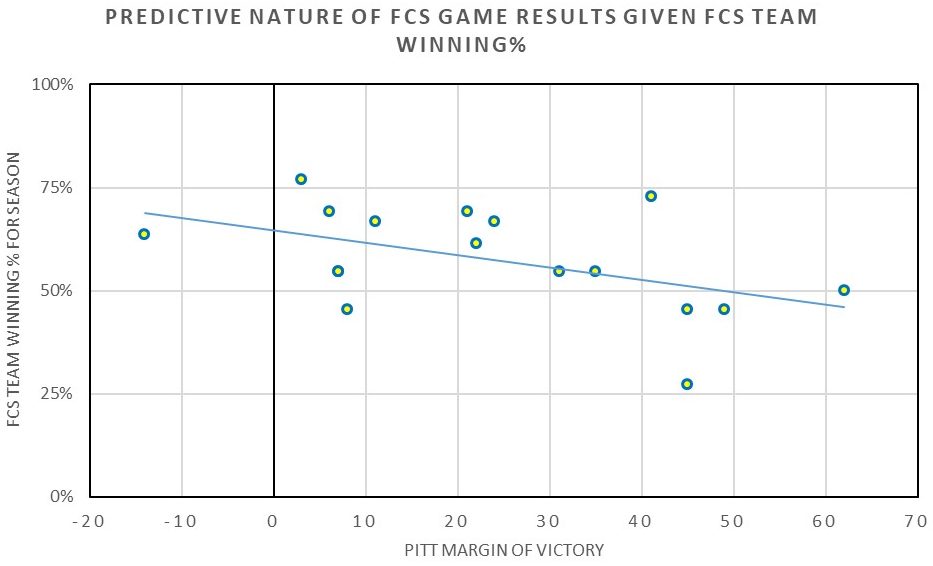
Generally speaking, the games above the line would be considered to be better results, as that would indicate that Pitt beat a quality FCS opponent by a healthy margin. Below the line means that it was a closer game against a team that isn’t even that great within its own level. This is of course very general and should be taken with a gigantic grain of salt, particularly due to the small sample size. Particularly at the right end of the spectrum, it’s less helpful as there are diminishing returns on the meaning of the margin of victory as it increases. I’ll also point out that I did not control for how good Pitt performed in the given season so as not to needlessly complicate things. With this in mind, let’s take a look at this chart again, but with Narduzzi’s three games called out:
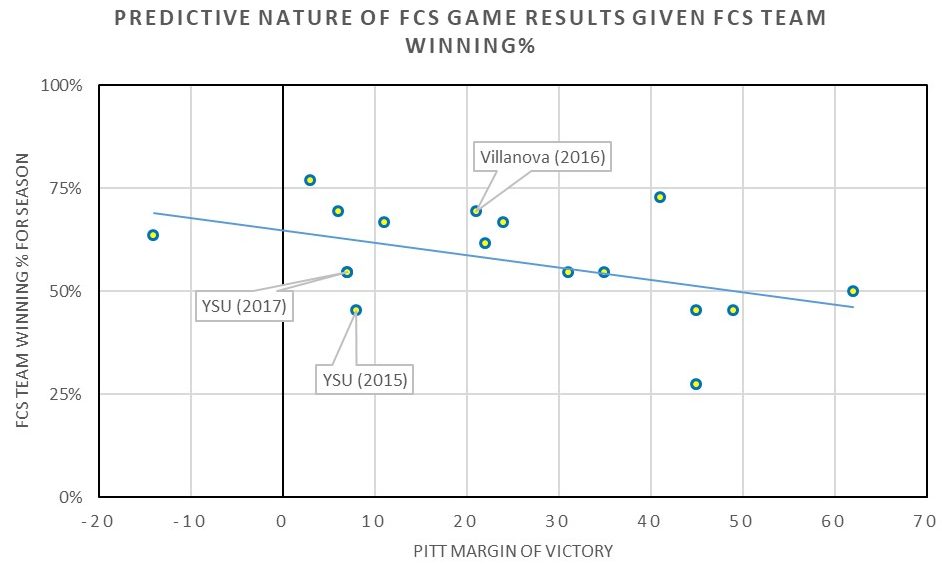
Most of the games you’ll notice either are right on the trendline or above it, as we would like to see. Even the 2016 game against Villanova, despite Pitt playing with a purposely hamstrung offense, looks better when you consider this, compare it to the other Pitt-FCS matchups, and realize that that Villanova team made it to the 2nd round of the FCS playoffs. However, what stands out are the two matchups with Youngstown State that the Panthers played under Pat Narduzzi. They’re both significantly below the line and were close enough for this to matter, given the concept of diminishing returns of margin of victory mentioned above. I’ll once again warn that it’s dangerous to read too much into this given the overall small sample size. However, the fact remains that Pitt under Pat Narduzzi has underperformed against this lesser competition and it’s reasonable to believe that the reason is due to the aforementioned vanilla gameplans.
All of this is a long way of saying that Pat Narduzzi should not strip down the playbook or allow his team to ease up at all when the Panthers play Albany on Saturday. Last year, Albany won 36% of their games and they aren’t expected to significantly improve. Even if we’re conservative and assume they’ll win close to 50% of their games this year, we should expect Pitt to stomp Albany by at least 40 points given their history. In fact, the 2015 game against Youngstown State was the only time Pitt has beaten an FCS foe that won less than 50% of their games in that season by less than 45 points (8 points). This isn’t to say that if Pitt only wins by 21 points, the game will be considered a failure, as there could be other circumstances at play in the game and Albany may turn out to be a better team than expected. However, there is no excuse for the Panthers to completely lay an egg in this game and if they lose it will either be because Albany got extremely lucky or Pat Narduzzi made a serious error in game planning, strategy, and player preparation. At the end of the day, it would also just be nice to see Pitt cruise to an easy win against an FCS opponent for once and save the stress for later in the season.
* Stats courtesy of College Football Reference
* Other information courtesy of sources linked
Have thoughts on the game this weekend or FCS matchups in general? Comment below or tweet at us @IntoPitt and @TheJeemTeam