
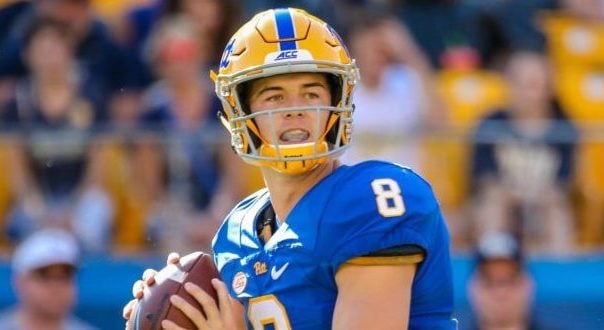
New Pitt Offense at the Season Midpoint
Much has been said about Shawn Watson and the unmitigated disaster that he was as the leader of the Panther attack during the 2017 and 2018 seasons. The frustration with the former Offensive Coordinator began shortly into his tenure and only got louder as it went on. Even as Pitt was winning the Coastal division last year, the general sentiment was that it was in spite of Watson. There was even some grumbling that the division title would save his job for at least one more season. I personally was dreading what we would see from a Watson-led offense without Qadree Ollison and Darrin Hall.
However, after clinching the division against Wake Forest, the Panthers offense fell flat in their final trio of games. The Pitt offense had a grand total of two touchdowns and an 8.67 points per game average over the final three contests, completed only 43.5% of their passes for a total of 275 yards (that’s total, not per game average), and the at times potent rushing attack disappeared with only a 3.66 rush average. Overall, the Panthers gained only 3.77 yards per play on average, which would have been dead last in FBS over the course of the entire 2018 season. After such anemic outputs to end the season Pat Narduzzi wasted little time in parting ways with the much maligned coordinator.
Eventually former UMass Head Coach and Pittsburgh Steelers Quarterbacks Coach Mark Whipple was hired as Watson’s replacement. There was guarded optimism with the announcement of this hire due to the reputation Whipple brought in with him as a quarterback mentor and a coach who loved slinging the ball. In other words, the polar opposite of what we saw under the previous leadership. While we aren’t even a full season removed from the end of that regime, and therefore are far from seeing how it will eventually turn out. Despite this, at the midpoint of the season and with a bye this past weekend, now seems like a good time to take stock of how the offense compares with that of the previous two seasons.
Before we get into these numbers, I’m aware that the Panthers have played some pretty tough defenses this year and have different personnel compared with last year and the year before. I will address that at the end. First, just the numbers though.
Run/Pass Split
[table id=13 /]
[table id=14 /]
As you can see from the above table, the average run/pass split nationwide for the past 2.5 seasons has been right around 55%/45% in favor of the run. In 2017, the Panthers were right there, within 1% of the FBS averages. Last year, the number of runs skyrocketed favoring the ground game by nearly a 65%/35% split. This was unsurprising as Qadree Ollison and Darrin Hall proved to be a reliable duo on the ground. This year it was expected that the pass game would be utilized more due to them leaving the program and Whipple’s reputation. Sure enough the needle has swung completely in the other direction to about a 43%/57% split in favor of the pass. It should also be noted that overall the Panthers are running more plays and have swung from below the FBS average for plays run per game each of the past two seasons to running on average over 8 plays more per game than national average in 2019. Needless to say, the Panthers offense looks dramatically different just by looking at the numbers as they are passing more and playing at a higher tempo. These numbers are no surprise to anyone who has actually watched the Panther offense since 2017.
Passing Game
[table id=15 /]
[table id=16 /]
We’ve already established that the Panthers are throwing the ball a lot more. Let’s take a look at the results of this additional passing. At first glance, the results are overwhelmingly positive as this year’s pass yards per game figure is much higher than each of the last two seasons. This is especially good when you consider that the difference is bigger compared to just last season when the Quarterback and top two Wide Receivers are the same. However, the difference in yards is completely due to the increased usage of the passing game. Each of the past two seasons has resulted in almost the exact same yards per attempt so far at around 6.3. Despite these relatively pedestrian yards per attempt figure, the Panthers are still averaging around 30 yards more through the air per game than the FBS average. It’s also worth noting that Kenny Pickett’s overall completion percentage has gone up slightly to 60.7% from 58.1% in 2018.
Running Game
[table id=17 /]
[table id=18 /]
Everyone was expecting less from the rushing attack this year, but I don’t think anyone expected the numbers to plummet as much as they have through the first 6 games this season. Both the rush yards per game and the average yards per rush numbers are way down compared to each of the past two seasons. While the rush yards per game decrease is maybe to be expected, it’s definitely disturbing to see the yards per rush average drop over 2 yards. They’ve gone from way ahead of the national average to way below it.
Overall Production
[table id=19 /]
[table id=20 /]
The Panthers are undeniably gaining more yards per game as a whole but, as with passing game, it appears to be due to the higher tempo at which they are playing. This is evidenced by the still lackluster Yards per Play numbers, which are down for Pitt this season compared to each of the past two seasons. Overall scoring is down as well with the points per game figures and offensive touchdowns per game numbers each being down as well. Almost any way you slice it, the Panther offense as a whole has not been as effective as last year’s unit except in terms of raw passing output.
Turnovers
[table id=21 /]
[table id=22 /]
Not much to report here, but I collected these figures and wanted to provide them as a bit of an interlude before I present my caveats and final thoughts. Fumbles lost has remained relatively static, but interceptions per game has gone up slightly, leading to slightly more turnovers per game overall compared with the Watson offense. I would be willing to bet that this entire uptick is due to the increased usage of the passing game though.
Caveats
So what’s the deal? Pitt was definitely right to get rid of Shawn Watson, but Mark Whipple hasn’t exactly turned this offense around. It looks different in terms of being more passing oriented, but in terms of effectiveness and production, if anything they’ve been worse. Well when comparing this year’s team with those from the Watson era, particularly last year’s, personnel needs to be taken into account. While Quarterback remained the same, the Panthers entire offense last season was basically built around Qadree Ollison and Darrin Hall. Not only are both of them now gone, but so are 4 of the 5 starters from last year’s offensive line which paved the way for them and were semi-finalists for the Joe Moore Award. Given this personnel turnover, the lack of production from the running game is disappointing, but not unexpected. Not helping matters, A.J. Davis and Vincent Davis have each missed the past two games with injury. Unsurprisingly, Pat Narduzzi has taken to listing all 4 Running Backs that have gotten significant snaps as co-starters with the “OR” designation between them all on the 2-deep in recent weeks. Even if the Panthers want to focus on the passing game now, they need a reliable running game to “keep the defense honest” and have it operating at a high level.
Another caveat to keep in mind is the quality of the defenses that the Panthers have faced. 4 of the 6 teams Pitt has played so far are in the Top 50 in the country in points per game and yards per game allowed. Virginia, Penn State, UCF, and Duke have all fielded defenses that can be considered among the best in all of college football so far this season.
[table id=23 /]
The Pitt offense has actually generally overperformed those respective averages when playing each of these teams. Against Penn State and UCF, Pitt scored more and gained more than they were giving up on average. Against Duke they scored more and barely fell shy of gaining more than the average yards they’ve given up (337 compared with a 345.8 average). Pitt did fail to hit both of Virginia’s season averages, but that was a season-opening game where the players were playing with the new offensive system in a game for the first time (and it showed). The good news for the rest of the season is that the only defense remaining on Pitt’s schedule that belongs in a class with those 4 teams is Miami, who are 26th and 18th in Points per game and Yards per game allowed respectively.
Final Thoughts
We’ve established that the offense has not improved, and if anything it has been worse than what we ever saw under Shawn Watson. Additionally, the statistics back up what we’ve all seen with our own eyes, which is that the overall philosophy has drastically changed from a run-oriented to passing-oriented attack. However, we shouldn’t despair given the caveats mentioned above. I fully expect the offense to perform much better as the season goes along. One would expect it to, simply due to the decrease in difficulty that opposing defenses will pose in the back half of the schedule. When you consider that the Offensive Line should improve as well, it’s not hard to imagine a unit that starts clicking by the end of the season.
*Statistics courtesy of College Football Reference
Let us know your thoughts on Pitt’s Offense by commenting, posting on the message board or tweeting at us @TheJeemTeam or @IntoPitt



Awesome work Jim!