For Panthers, a Year of Significant Player Development Should Soon Be Followed by On-Court Results
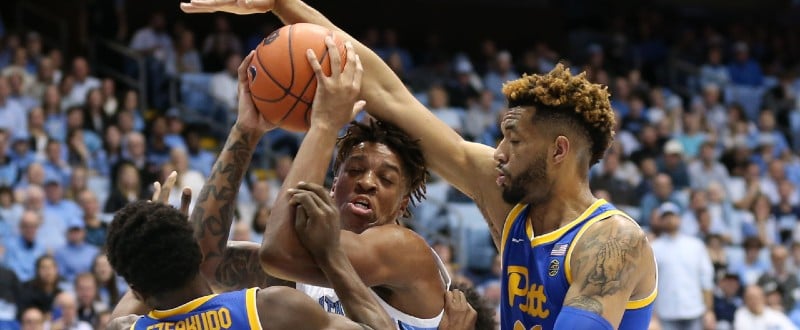
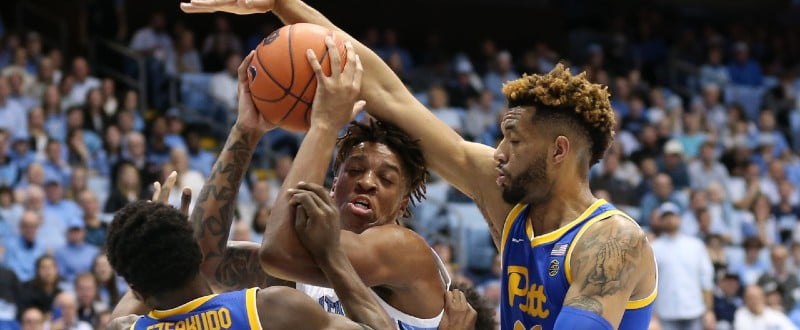
Georgia Tech head coach Josh Pastner heaped praise onto the Panthers following Pitt’s 73-64 victory over the Yellow Jackets on Saturday, Feb. 8. Among the highlights? Pastner noted that he thinks Pitt could be among the ACC’s top three or four teams in the 2020-21 preseason rankings.
That is certainly high praise for a program that is less than two seasons removed from a 0-18 conference finish, and which finished with just three conference wins last season. And despite Pitt winning a combined three ACC contests over the most recent two seasons, those dreadful ACC finishes feel like they belong to the distant past with wins like Saturday’s against the Yellow Jackets.
The star of the game was undoubtedly freshman Justin Champagnie, who put up video game numbers to the tune of 30 points on 12 of 17 shooting (including three of four from beyond the arc), with nine rebounds, two steals, and zero turnovers. Truly, that is a performance for the ages.
And while Champagnie may be the breakout star for the 2019-20 Panthers, the overall story for this Pitt program is one of a season’s worth of development from each of its four returning players from last season–Au’Diese Toney, Xavier Johnson, Trey McGowens, and Terrell Brown. How, exactly, has each developed?
Au’Diese Toney
The player who jumps off the page in terms of clear skill development is Au’Diese Toney. A switch flipped for the sophomore forward at the end of November 2019, and he has not looked back. In 14 games dating back to Dec. 3, 2019 (10 ACC contests), Toney is shooting an excellent 51.4 percent from the field, including 34.4 percent from three-point range.
For a Pitt team that shoots just 41.4 percent overall and 30.3 percent from beyond the arc, Toney has been an absolute offensive force over the past two months. His finest moment of the season was a 27-point performance in Pitt’s 79-67 loss to Duke in Durham, N.C. in January, but the hallmark of his torrid stretch has been consistency.
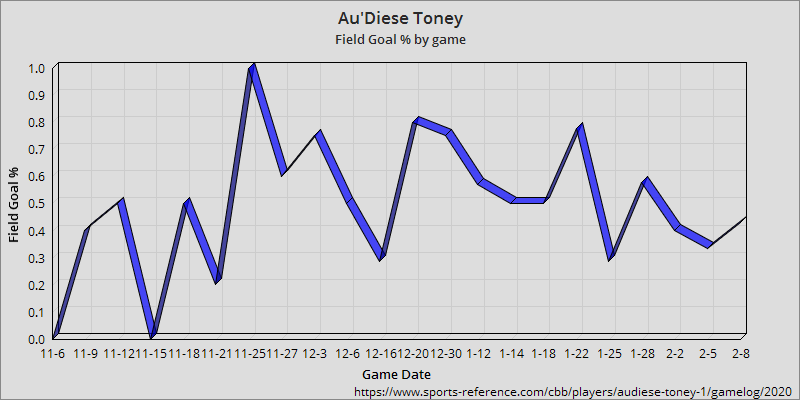
This chart should make clear that Toney has shot very well dating back to the end of November. Since Nov. 25, 2019, Toney has shot worse than 30.0 percent from the floor just twice in 16 games, while shooting 50.0 percent or better a whopping 11 times.
Overall on the season, Toney’s effective field goal percentage is up from 39.9 percent as a true freshman to 50.7 percent this year. The numbers are even more pronounced in ACC play, as Toney improved from a 34.2 effective field goal percent in 2018-19 to 52.1 percent in-conference this season. That is a massive improvement, which takes into account his modest improvement from three-point range in addition to his significant improvement from the mid-range.
Of course, Toney’s calling card even before his offense took off was his defense and rebounding. Toney provided the Panthers with a stout defensive presence against tough offensive matchups, and that certainly cannot be understand.
Toney has averaged 5.1 rebounds and 1.0 steals per game this has year, including a very similar 5.5 rebounds and 1.2 steals per game in ACC play. It is rare to see a player maintain their numbers going from a relatively weak out-of-conference schedule to the grueling ACC slate, but Toney has managed to do just that this year.
If he can continue to perform near the bar that he has set for himself over the past two months, Toney is going to be a very important factor for Pitt’s success for the rest of this season, and for the next couple of years.
Xavier Johnson
Is there a more polarizing player for this year’s Pitt team than Johnson? The sophomore guard turned heads last season as he seemingly came out of nowhere to post excellent numbers as a true freshman and ultimately land himself on the All-ACC Freshman squad for the 2018-19 season.
After such a promising start, the expectations for Johnson’s sophomore campaign ballooned, and it would be fair to say that he did not live up to those expectations at the start of the season. That starts with his shooting, which has unquestionably taken a hit from last season.
This year, with 12.0 points per game on 38.2 percent shooting (34.8 percent from three), Johnson remains an effective three-point shooter, but has struggled to score inside like he did last season. Given that his unique ability to drive to the basket resulted in much of his scoring success last season, fans expected that he would build upon that success this year.
Of course, ACC defenses have now had more than a year’s worth of experience facing Johnson, and they have adjusted. It hasn’t been as easy for him to get to the rim this year. Nevertheless, as just a sophomore, I would not bet against Johnson to adapt once more and find a way to consistently get back to the rim.
And while I wouldn’t bet against Johnson to improve moving forward, his shooting this year has not been an area of major skill development. But to find improvement for Johnson, we don’t need to look far.
As a playmaker and offensive facilitator, Johnson is leagues better than he was last season. In 2018-19, Johnson finished ACC play with a dismal 4.2 assists and 4.4 turnovers per game. Those numbers actually got worse as the 2018-19 conference slate played out, as Johnson final 16 conference games were marked by just 4.0 assists and 4.5 turnovers per game.
This season, though, has been a different story. In ACC play this year, Johnson has posted 4.8 assists and just 2.9 turnovers per game. Already, we see marked improvement in Johnson’s ball protection and facilitation skills and decision-making.
But his numbers have been even more impressive over the past month. Since Jan. 12, 2020 (nine games), Johnson has posted 5.7 assists and just 2.4 turnovers per game. How big of a change is that? Johnson went from a 0.95:1 assist to turnover ratio one year ago (i.e. more turnovers than assists in ACC play), to a 2.38:1 assist to turnover ratio over the past month.
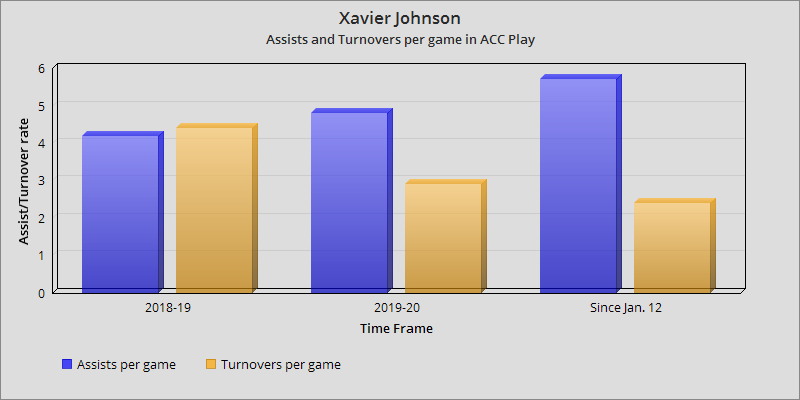
His scoring struggles have been well-documented, and they certainly should not be ignored. But the Panthers will be just fine with Johnson scoring less if he can continue to facilitate the offense as well as he has done since mid-January.
Especially with scorers in this offense like Champagnie, Toney, and McGowens, you could make a convincing argument that Johnson’s improved ability to run the offense is the biggest development for the Panthers this year.
At the very least, it has opened up the floor for Pitt’s scorers and taken the pressure off of Johnson to do it all himself. If Johnson keeps improving as a facilitator at this rate, and if he can once again become elite at driving to the rim, he very well could still have an NBA future.
Trey McGowens
Much like Johnson, McGowens has improved as a facilitator. Having Champagnie and a much-improved Toney to help out with the scoring has no doubt benefitted McGowens’ game. Everyone remembers the moments from last season, and to some extent this season, during which McGowens would try to single-handedly take over the game himself.
And look, it definitely worked at times last season. Who could forget his 33-point and 30-point games in upset wins over Louisville and Florida State in January 2019? When the sophomore shooter is on his game, it can be hard to stop him.
Of course, much like Johnson, McGowens’ raw shooting numbers are down a little bit this year. After shooting 41.7 percent overall and 32.7 percent from three-point land a year ago, McGowens has shot just 37.8 percent overall and 30.1 percent from deep this year. The numbers are even worse in ACC play, where he is shooting just 32.3 percent overall and a dismal 29.2 percent from three.
And yet, McGowens has posted a solid 15.9 player efficiency rating this year, which matches his mark from last season. The fact that he has continued to put up overall solid numbers despite markedly worse shooting is a testament to just how much he has improved this year in all other aspects of his game.
In 2019-20, McGowens has more than doubled his assists per game, from 1.7 per game last year to 3.7 per game this year, without seeing much of an increase in turnovers per game (2.4 per game last year vs. 2.7 per game this year).
And just as is the case with Johnson, the numbers are even more pronounced during ACC play. Last season, McGowens was overwhelmed by the ACC competition, posting 1.8 assists and 2.6 turnovers per game. This year, his assists in conference play are all the way up to 4.7 per game, with 2.8 turnovers per game.
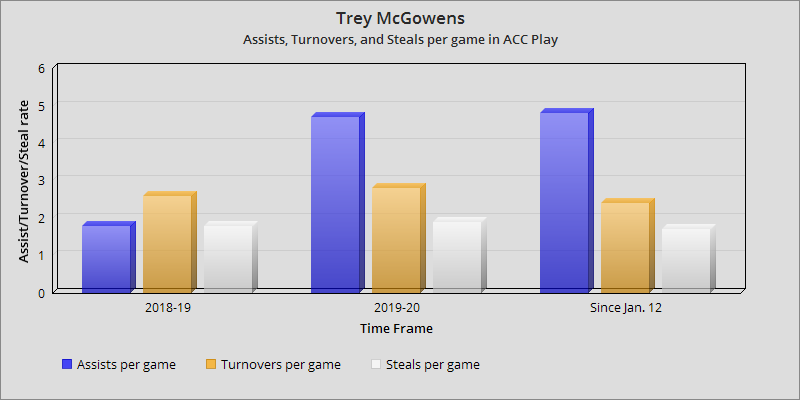
As far as the underlying numbers go, McGowens’ assist percent (the percentage of teammate field goals that McGowens assisted while he was on the floor) has more than doubled from 14.6 percent last year to 30.9 percent this year. Meanwhile, his turnover percent is down from 19.6 percent last year to 16.5 percent this year.
Just as was the case with Johnson, McGowens has managed to become a much better facilitator this year in that he’s become much better at protecting the basketball and making careful passes to the other scorers on the team. This was on full display against Georgia Tech on Saturday, as McGowens and Johnson combined for 16 assists and just two turnovers.
Don't sleep on Trey McGowens and Xavier Johnson, though. The sophomore guard duo combined today for 25 points, 16 assists, and just two turnovers.
HUGE play today from Pitt's backcourt.
— DreamBackfield.com Hoops (@PittHoops) February 8, 2020
Defensively, McGowens has also continued to play great basketball, and he’s averaging 1.9 steals per game on the season. He has shown great skill in interrupting passing lanes, and his defensive rating (the estimated number of points allowed per 100 possessions), has likewise improved this season from 106.8 last year to 102.6 this year.
McGowens is a shooting guard, and he needs to shoot the ball better to realize his full potential. But his defensive work and his improvement with the ball in his hands have resulted in a much more complete basketball player, and a cornerstone for Capel’s program.
Terrell Brown
Last but not least is Brown, the junior center and holdover from the Kevin Stallings era, who can be polarizing in his own right. Much like Toney, Brown is having far and away his best season as a Panther in 2019-20, as I noted on Twitter following Pitt’s 66-52 victory over North Carolina on Jan. 18, 2020.
Brown is shooting 70% in ACC play, turning the ball over about *one-third* as often as he did last season in ACC play, and is still an excellent shot blocker.
The rebounding hasn't been there, and he can be very inconsistent. But these are major strides overall.
Brick by brick. https://t.co/7SKpAml8OC
— DreamBackfield.com Hoops (@PittHoops) January 18, 2020
For starters, Brown is shooting 53.9 percent from the field this year, and 56.5 percent from two-point range, which is a remarkable improvement from the past two seasons, when he shot 41.8 percent and 43.6 percent from the field, respectively.

That’s bona fide improvement, right? Well check out his numbers in ACC play going back to his freshman year. The difference is even more stark. To go from a field goal percentage of just 38.2 percent as a true freshman all the way to a 64.6 percent field goal percentage this year can be considered nothing short of a remarkable improvement.
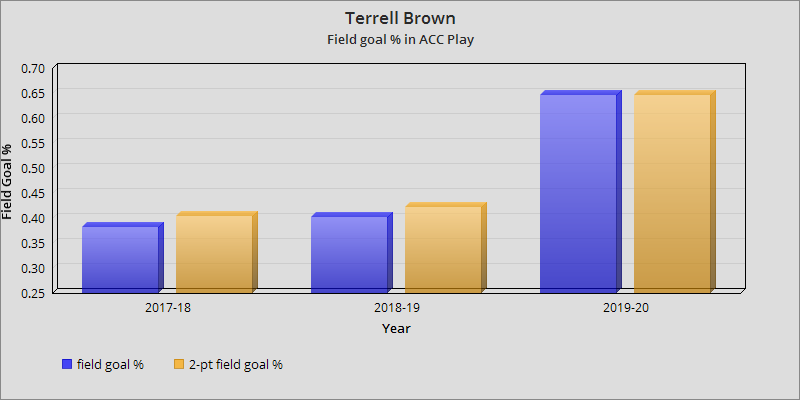
But Brown has continued to improve other aspects of his game as well, and he’s become a fine ACC-caliber center as a result. Brown’s 11.9 percent block rate ranks no. 10 in the country, between Purdue’s Matt Haarms (12.0 percent) and Texas A&M’s Josh Nebo (11.4 percent).
In ACC play, Brown has seen his offensive rebound percentage improve for the second straight year, from 7.6 percent as a true freshman to 8.3 percent last season to 10.7 percent this season. Overall, his rebounds are down this year because he has not done as well on the defensive boards, but I think that is in part due to the emergence of Champagnie as an excellent defensive rebounder.
With Champagnie scooping up more defensive boards, there are fewer opportunities for Brown to collect them. But his improvement on the offensive boards reveals a center who is becoming more comfortable and skilled at winning the tough battles against ACC big men.
Defensively, his steal rate has more than doubled this season, from 0.4 steals per game last year to 1.0 steals per game this season. Meanwhile, his turnovers per game are down from 1.1 per game a year ago to 0.8 per game this season.
The Takeaway
In theory, Pitt still has a chance to make the NCAA tournament this season. But it would take a whole lot for the Panthers to get there–winning the remainder of their winnable games, pulling off an upset or two, and winning a couple of games in the ACC tournament.
At the end of the day, the story of Pitt’s 2019-20 basketball season will be one of significant improvement. The Panthers returned four players from the 2018-19 squad, and each has shown significant improvement in important phases of the game.
Capel and his staff deserve a ton of credit for their ability to work with these players on developing aspects of their games that may not have initially come naturally to them–Toney’s shooting, Johnson’s and McGowens’ ball protection and offensive facilitation, and Brown’s inside scoring and offensive rebounding.
The most promising thing about this development for Pitt is that as of now, each of these four players is expected to return to the team next season. If they can all take another small step forward, along with Ryan Murphy and the three true freshmen on the team–Champagnie, Gerald Drumgoole, and Abdoul Karim Coulibaly–the Panthers are looking at a very strong foundation for the 2020-21 season.
And if transfer Ithiel Horton and incoming freshmen John Hugley, Noah Collier, and Max Amadasun are able to add anything to the mix, this could ultimately be the most talented and deep Pitt basketball team that we have seen in at least half a decade.
While Pitt has proven this year that it can hang with just about anybody in the ACC, perhaps Pastner is right–the Pitt Panthers just might be one of the best teams in the ACC next year. Whether the Panthers break back into the NCAA tournament this year remains to be seen, but surely it will not be long until they once again find themselves dancing in March.