Darrin Hall and Qadree Ollison: A Look Back at the Pitt Running Back Tandem
Today, we’re going to take a look at the Past, Present, and Future of recently departed Pitt Running Backs Darrin Hall and Qadree Ollison
After historic senior years, Pitt Running Backs Qadree Ollison and Darrin Hall’s college careers are now over. What did the duo do this past year to consider their final campaigns historic? They only rushed for 1,213 and 1,144 yards respectively, becoming the first pair of Pitt teammates to rush for over 1,000 yards in the same season. Additionally, it wouldn’t be hyperbole to say that this year’s team would have been in trouble without these two guys having such great seasons. With former Offensive Coordinator Shawn Watson’s awful play-calling and aversion to a modern passing attack, it’s extremely unlikely that Pitt would have won the Coastal division and earned a Sun Bowl bid without the stellar play of the two seniors (not to mention the blocking work done by the Offensive Line and Fullback George Aston).They were recognized as All-ACC selections after the season for their exploits, with Ollison being selected to the 2nd team and Hall the 3rd team. Both players undeniably had a successful final season with the Panthers after both had a up-and-down times at Pitt. Now that their college careers are over, it’s time to take a look back at their time with the Panthers, begin determining their place in the pantheon of the school’s great Running Backs, and looking at what may be next for the two.
Qadree Ollison
Qadree Ollison came to Pitt in the Class of 2014, the final group brought in by former Head Coach Paul Chryst. According to the 247 Composite Rankings, he was rated as 3-star and ranked as the 51st Running Back and 6th in the state of New York. Ollison was fairly heavily recruited, with offers from 10 Power 5 schools including Penn State. Chryst also contended with Wisconsin, his alma mater and future employer, in attempting to sign Ollison. He would beat out the Badgers to land the Buffalo native, bringing him to Pittsburgh. Ollison would burst out in a big way in 2015, following taking a redshirt his first year. An injury to James Conner in the 2015 season opener gave him a chance that he seized, rushing for 207 yards against Youngstown State. After it was revealed that Conner’s injury would keep him sidelined for the entire season, Ollison was promoted to full-time starting Running Back. He took advantage of the opportunity and rushed for an impressive 1,121 yards, topping 100 yards in 5 games and averaging 5.3 yards per rush in the process. He won ACC Offensive Rookie of the Year, beating out Lamar Jackson, and tied with teammate Jordan Whitehead for the overall conference Rookie of the Year award.
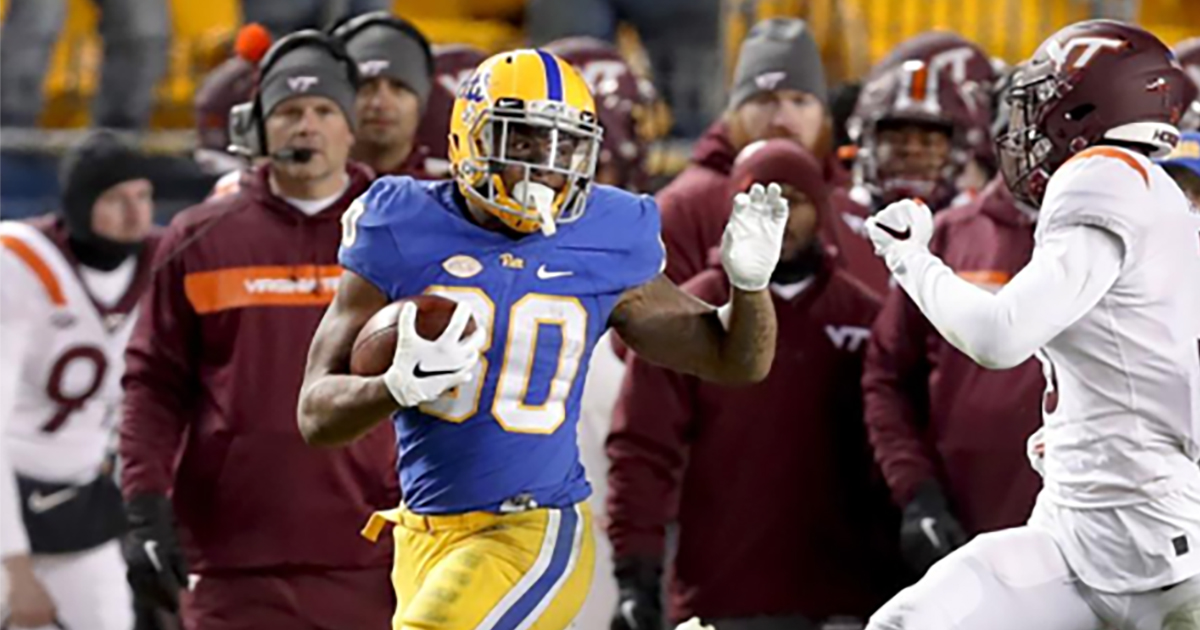
The next season James Conner returned and took back over as starting Running Back. Ollison was still expected to contribute though given his breakout season. However, new Offensive Coordinator Matt Canada’s offensive system often utilized jet sweeps and shovel passes in lieu of a traditional rushing attack. While Conner had a nice season, recording nearly 1,400 yards from scrimmage, Ollison found himself buried in the depth chart in a crowded group of Running Backs. He was the 6th leading rusher and 4th among the Running Backs on the team with only 127 yards. His 36 yards against Penn State represented a season-high in any game and there were 5 games where he failed to record a single rushing attempt. Conner was of course the leading rusher, but Chawntez Moss was utilized more and more as Conner’s primary backup as the season went along.
The next season saw Ollison starting out strong with performances of 91 and 96 yards respectively in the first two games against Youngstown State and Penn State. Unfortunately, those two totals would represent season highs. Ollison would improve on his previous year’s total, but the 398 yards he recorded were still a far cry from his rookie campaign. His low totals this season were due to a confluence of factors generally outside of Ollison’s control though. They included the inability of the Panthers to find an effective full-time starting Quarterback to allow for a balanced offensive attack, weak offensive line play that hampered the running game as a whole, and the introduction of the inept Shawn Watson as offensive coordinator. Also hampering the overall running game and Ollison’s ability to accumulate yards was the loss of fullback George Aston for virtually the entire season due to injury. By the end of the season, Hall was being utilized as the primary halfback, while Ollison was more and more taking Aston’s role in the offense.
This past season finally saw Ollison return to the types of performances that we had seen him turn in his first year playing. He led the team in rushing with 1,213 yards, the most rushing yards in a season by a Panther since James Conner rushed for 1,765 en route to winning ACC Player of the Year in 2014. He only topped 100 yards 4 times, but he was much more consistent than he had been at any time the past two seasons. The only games where he failed to record 40 rushing yards were two games he was pulled early for precautionary reasons due to injury and the Miami game that could be used as Exhibit A when asked for evidence of why Shawn Watson was fired. Ollison also averaged 6.3 yards per rush, a full yard higher than the 5.3 he averaged when he was ACC Rookie of the Year. To top it off, he now owns a place in the Pitt record books for his 97-yard touchdown run against Virginia Tech, which is now the longest play from scrimmage in the school’s illustrious history.
Qadree’s career at Pitt definitely had a strong opening act and a stirring finish, but for several reasons, generally outside of his control, the middle portion was disappointing. In today’s college football landscape where players are so quick to transfer out of a program if things aren’t perfect, Ollison deserves a lot of credit for sticking things out at Pitt when he easily could’ve transferred to another school. Qadree also had to overcome a personal tragedy when his older brother was murdered during the 2017 season . Ollison didn’t have the smoothest career during his time at Pitt, but he persevered, was named all-conference, played in an ACC Championship, and has a shot at playing on Sundays.
Darrin Hall
Darrin Hall was a 247 composite 4 star recruit out of Youngstown, Ohio when the Panthers signed him as part of the Class of 2015. He was an impressive prospect with 15 Power 5 offers including West Virginia, Louisville, and Arkansas. In the end though, it was Michigan State that Pitt had to beat out to land him. Hall initially committed under former Head Coach Paul Chryst, but stuck with the Panthers after he left to take the same job at Wisconsin and signed as a part of Pat Narduzzi’s first recruiting class. Rated as the 25th best Running Back in the country in the Class of 2015 and the 14th Overall prospect in the talent-rich state of Ohio, Hall was considered, along with Jordan Whitehead, to be the stars of the class that year for the Panthers. A reflection of his prospects was the fact that he didn’t redshirt his first year and played in 10 games as a true freshman.
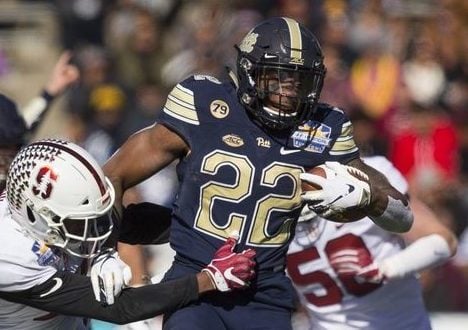
While Hall did see significant playing time as a true freshman, he probably wouldn’t have appeared nearly as much if it wasn’t for the previously mentioned injury to James Conner. In fact, with the more experienced Chris James as a part of the backfield at the time, it’s likely that he would’ve sat out the whole season. It turned out that the regular season finale against Miami would be his coming out party though, as he rushed for 103 yards and a touchdown on only 12 carries. That game alone accounted for over 40% of his rushing yardage for the season. However, it created buzz around the young Running Back and boded well for Pitt’s proud Running Back tradition to continue over the next several seasons.
2016 saw the return of James Conner and, as with Ollison, it was expected that Hall’s opportunities would drastically decrease. However, Hall found himself behind not just Conner but newcomer Chawntez Moss as well. Hall only appeared in 9 games and never recorded more than 6 carries in any of the contests. As with Ollison, the new offensive scheme under Matt Canada did Hall no favors due to the ample use of jet sweeps and shovel passes. Hall’s season-high output of only 33 yards came in the Penn State game. Although Conner was leaving for the NFL, Ollison and Moss would be returning, as well as highly touted freshmen A.J. Davis and Todd Sibley. Between all of this, it wasn’t unreasonable to anticipate Hall wanting out of the program for an opportunity for better playing time. However, like Ollison, he stuck around hoping to make an impact his Junior year.
During the first half of the season, it looked as though Hall may have made a mistake to stay at Pitt. While he had 13 carries in the opener against Youngstown State he would only record 9 over the next 5 games, which included a period of 3 games where he only received one handoff. However as mentioned above, the entire offense struggled that season. That likely was little consolation through the first 7 games of the season as Hall found himself with only 108 rushing yards over halfway through the campaign. Because of this, there was no reason to expect what occurred when the Panthers met the Duke Blue Devils in game number 8. A 254-yard outburst from Hall instantly more than doubled his season yardage to that point. He would also score all 3 touchdowns in the 24-17 victory. Notably, his 92 yard scamper in the 3rd quarter set the record for longest play from scrimmage in program history at the time, a record that barely stood for a year as it was broken by the other subject of this piece. Hall kept things rolling with 100-plus yard performances in the next two games and ultimately finished the season with 628 yards, accumulating 520 of them in the final 5 games.
Hall saved his best for last at Pitt, rushing for 1,144 yards and 10 touchdowns as co-starter at Running Back. Though he had a slow start, failing to top 30 yards rushing in any of the first three contests, he would finish strong. Over the final 11 games, he would top 100 yards 4 times and never fail to go for at least 40 yards. All of this despite sharing a backfield with Ollison and garnering over 40 less carries (194 for Ollison and 153 for Hall). This resulted in him actually averaging over a yard more per rush than his partner in the backfield (7.5 for Hall and 6.3 for Ollison). That figure actually put Hall at 8th in the country in yards per rush among qualified players and 2nd in the ACC (trailing Travis Etienne of Clemson with 8.1).
Much like Ollison, Hall likely could have transferred out of the program and received more playing time elsewhere. I wouldn’t have even faulted him for doing so and honestly that offseason between his sophomore and junior years I kept waiting to hear the news that he would be transferring. He stuck around though and finished his Pitt career on a high note, rushing for over 1,000 yards, being a key member of the first Pitt team to win an ACC division title, earning all-conference honors, and hopefully setting himself up for a pro career.
Places in Program History
Pitt has deservedly earned the moniker RBU in recent years for their propensity to have great Running Backs come through the school. This goes all the way back to Marshall Goldberg and the Dream Backfield of the 1930’s for which this very website is named. There is of course also Pitt’s only Heisman Trophy winner Tony Dorsett, who may have an unassailable claim to the title of best Running Back in program history. Even during Pitt’s lean years in the late 1980’s and 1990’s, they had stars in Craig “Ironhead” Heyward and Curtis Martin, both of whom would enjoy fruitful NFL careers with Martin eventually earning election to the Pro Football Hall of Fame. More recently, LeSean McCoy is likely a future Hall of Famer and Dion Lewis and James Conner have followed up stellar careers at Pitt with nice pro careers of their own. With Qadree Ollison and Darrin Hall’s college careers now at an end, it’s time to ask, where do they compare to these luminaries in the illustrious Running Back tradition at the University of Pittsburgh.
Tony Dorsett and Marshall Goldberg are the only ones mentioned above who can lay claim to having won a National Championship during their time at Pitt and Dorsett is the only one, and only Panther ever, to win the most coveted individual award in college football, the Heisman Trophy. The two are also the only Pitt Running Backs to be named Unanimous All-Americans, though Craig Heyward and James Conner were also named AP All-Americans. When looking at post-college exploits, Dorsett, Curtis Martin, and LeSean McCoy would likely be considered as those with the greatest professional careers with the first two in the Hall of Fame and McCoy likely to join him following the completion of his time in the NFL.
From a statistical standpoint, right off the bat Hall and Ollison own a spot in the Pitt record books that none of the other luminaries mentioned above, or any Panther for that matter, can lay claim to. As mentioned above, both own the two longest plays from scrimmage in Pitt football history, with Hall setting the record against Duke in 2017 with his 92-yard Touchdown rush and Ollison breaking his backfield partner’s record this past November against Virginia Tech with his 97-yarder. Of the players mentioned above, only Dion Lewis and Curtis Martin even have plays that gained at least 80 yards. Over the course of a whole game though, only Darrin Hall can claim a spot in the record books. Though neither ever came close to Dorsett’s single game record of 303 yards against Notre Dame in 1975, Hall came the closest with his 254-yard output against Duke in 2017. This puts him into a tie with Craig Heyward (1984 against Miami) for 10th on the list of all-time rushing performances by a Panther.
[table id=9 /]
Qadree Ollison’s career-high, 235 yards in the aforementioned Virginia Tech game, is well shy of a spot among the Top 10.
Both players miss the mark for statistical greatness over the course of an entire season. Over this period of time, Tony Dorsett is once again in a class of his own with his 2,150 yards in 1976. Ollison, Hall, and no other Panther have come anywhere near him in this metric. Dion Lewis came the closest when he rushed for 1,799 yards during the 2009 season.
[table id=10 /]
Even with both players getting the benefit of playing in 14 games this past season, neither were able to crack the Top 10. So while Ollison and Hall’s 1,213 and 1,144 rush yards respectively this past season are great marks, they wouldn’t be considered in the top tier. It must be noted though, that the two players took carries away from each other. Both players performed so well that neither was ever really utilized as a true primary back. More on that later though.
Continuing a recurring trend, Dorsett sets the standard when looking at career rushing yardage. With 6,526 yards, the Heisman Trophy winner is not only the leading rusher in Pitt history, but 3rd overall in NCAA history (when bowl stats are included), behind Wisconsin’s Ron Dayne and Texas’ Ricky Williams, who are 1st and 2nd respectively. There is quite the gulf between the 3,733 career yards from James Conner, Pitt’s 2nd all-time leading rusher, and Dorsett’s astronomical total. In fact, the 2,793-yard difference would break the NCAA single season rushing record (2,628 by Oklahoma State’s Barry Sanders in 1988) by over 150 yards. To put it another way, Dorsett could have spotted Conner or any other Panther an entire extra season and the chance of them catching his record is slim to none.
[table id=11 /]
This isn’t to say that Ollison and Hall didn’t have respectable outputs themselves. Ollison finished with 2,859 career rushing yards and Hall recorded 2,189 rushing yards during his time in Pittsburgh. Ollison’s output puts him at 7th all-time on the Panther career rushing list, ahead of greats such as Curtis Martin and LeSean McCoy. While Hall failed to crack the Top 10 himself, he is still in an elite group as one of the few Panthers to rush for over 2,000 yards in their careers. In fact, each player is one of only 15 to hit that mark for their career.
Beyond just simple yards, Ollison and Hall each put up respectable statistics. They each make the Top 10 for career rushing touchdowns by a Panther running back with 29 (T-6th) and 21 (9th) respectively. While they weren’t the receiving threat that you often see from Running Backs nowadays, that may be due more than anything to Shawn Watson’s antiquated offense from the last couple seasons. Even so, they each ended their career with a receiving touchdown (with Ollison recording 3). Finally, Hall’s aforementioned 7.5 average yards per carry over this past season absolutely smashes the previous school record of 6.6 yards per carry set by Tony Dorsett (min. 1,000 yards).
So after going over all of this, where does this leave the duo. Dorsett remains in a class of his own and comparisons with Marshall Goldberg are difficult to make with any more recent players due to the different nature of the game today and the fact that there are very few alive today who can claim to have seen him play. LeSean McCoy and Curtis Martin, though both having nice careers at Pitt, are more known for their exploits after leaving Pittsburgh and as that chapter is yet to be written for each of their career’s, it’s difficult to judge McCoy and Martin’s complete or near-complete legacies against theirs. Honestly, coming up with a sensible ordering of all the great Pitt Running Backs is difficult once you get past Dorsett being the obvious Number 1.
When it comes down to it, they have each etched their place in Pitt’s record book for their aforementioned long touchdown runs and career yardage totals. They also have the unfortunate distinction of sharing much of spending the early portion of their careers in the shadow of James Conner and the latter portion of their careers in an outdated offense. It isn’t hard to make the arguement that if it wasn’t for the outstanding play of these two (as well as fullback George Aston and the offensive line) this past season would’ve been a disaster of epic proportions. They may have been the only thing that allowed former Offensive Coordinator Shawn Watson to keep his job as long as he did. Between all of this, one wonders how much they could’ve done had the circumstances of their time in college been different.
However, we have to go on what we have seen in their careers. There are many different caveats, both that helped and hindered careers, to describe many different players’ times at Pitt. For example, in the four seasons that Curtis Martin played for Pitt, the Panthers had an overall record of 15-30 and only had a winning season once (6-5 in 1991 as a Freshman). Martin is considered one of the greatest Running Backs to ever play for Pitt and he never even played in a bowl game. Unsurprisingly, this status has seemed to have been conferred upon Martin retrospectively in response to his Hall of Fame career. So it may prove to be for Ollison and/or Hall, should one or both of them go on to have an illustrious NFL career.
Given these caveats and the desire to mitigate a legacy being colored by achievements that occurred following a player leaving Pitt, when determining their places as given below I have attempted to give much more weight to the college careers of the greats they’re being compared against. All of this being said, Tony Dorsett is in a class of his own when it comes to comparing Pitt Running Backs. He is only Heisman Trophy winner in program history and has a school record for career rushing yards that may never be broken. I think it’s extremely likely that none of us will see a Pitt Running Back as great as him in our lifetimes. After him, I would put Marshall Goldberg, though it is hard to compare his exploits against those that occurred after World War II given how much the game changed and the lack of reliable statistics and film from the era. As a compromise I would place him beneath Dorsett, but above the rest to show how important he is to the program despite many casual Pitt followers may not even knowing who he is. After these two, things get much murkier. To me, James Conner, Dion Lewis, and Craig Heyward go into the next tier by virtue of having all either been named an All-American or winning a conference Player of the Year award. Conner and Lewis each accomplished the former (Conner in the ACC, Lewis in the Big East), while Heyward was a 1987 consensus All-American. During this time Pitt was independent and he was therefore ineligible for a conference Player of the Year award.
Under this criteria, Billy West should also qualify for this tier of greatness, but he only averaged 4.9 yards/carry for his career and accumulated nearly half of his career yards during his sophomore season in 1994, the same year he won his Big East Conference Player of the Year award. After that season he only recorded 1,201 yards over the next 3 seasons and went undrafted after graduating. In his stead we will put LeSean McCoy in this tier. Shady only played for Pitt for two seasons before leaving for the NFL. Despite this, he is still 8th in career rushing yards in school history and 3rd in career touchdowns.
So we’ve determined who the best Running Back and the next 5 best (in no specific order) are in program history. I’ve placed 8 former Panther Running Backs into the next tier, giving us who I believe to be the 14 greatest* Running Backs in program history. It is here that our journey ends, though I’m sure many of you reading may have some sentimental favorites in players like LaRod Stephens-Howling or Joe McCall, I’ll have to leave you with these final 8 players in no particular order: Ray Graham, Curvin Richards, Billy West, Elliott Walker, Curtis Martin, Kevan Barlow, Qadree Ollison, and Darrin Hall. Players such as Graham and Richards were very good for a sustained period of time, but may have never looked particularly great and never won significant accolades while in school. West as mentioned above had the opposite issue. Martin as mentioned above made more of a name for himself after leaving Pitt. Elliott Walker is a bit of a unique case, having spent the majority of his career in Tony Dorsett’s shadow as his backup. He still rushed for over 900 yards in 1975 and when he finally got to start, he led the team in rushing with 1,025 yards as the Panthers went on to win the Gator Bowl.
*I’m sure I’m omitting some greats who were contemporaries of Goldberg
It is in this group that I feel Qadree Ollison and Darrin Hall belong. Basically, they should not be considered Top 5 Running Backs, but they are in the Top 15 in program history. Though this team has not won as much as we would have wanted them to in recent years, we should consider ourselves lucky as Panther fans to have seen these two great players share a backfield together. If pressed I would probably rank Ollison ahead of Hall due to his more overall yards and ACC Rookie of the Year award from his first season. However, it’s not really fair to directly compare them as they were different types of players. Hall was a more elusive back, while Ollison could just bowl you over (though he looked a lot faster and agile his senior season). These differing styles were nice because sometimes one of them couldn’t get things going against an opposing defense, so the other would go out as a change-up and things would often open up for the Panthers. This 1-2 punch was potent at times this year and it is a huge reason that Pitt was able to win the Coastal division. This doesn’t even mention the fact of them being the first duo to rush for 1,000 yards in the same season for the Panthers. For these reasons, I would say they are the best Pitt backfield pair since the fabled Dream Backfield.
What’s Next for Hall and Ollison?
The NFL will hold their annual draft in Nashville, Tennessee next month from April 25-27. Qadree Ollison and Darrin Hall will hope that their names will be one of the 256 names called over the 3-day event. It’s unfortunately far from guaranteed that this will occur though. The other 6 players that occupy my created 3rd tier of Pitt Running Back greats along with Hall and Ollison had a wide spread of draft positions. Curtis Martin and Kevan Barlow were drafted 74th and 80th respectively right in the middle of the 3rd round then and now. Not far behind them Curvin Richards was selected 97th, which will be in the compensatory picks section at the end of the 3rd round in this year’s draft, but was well into the 4th round when he was selected in 1991. There is a sizeable gap before the draft position of Elliott Walker who was taken 148th in 1978, then a 6th round pick, but part of the 5th round in this year’s edition. The other two former Panthers in this tier, Ray Graham and Billy West went undrafted, though Graham did sign with the Houston Texans as an undrafted Free Agent and played in 1 game with them in 2013. It’s very likely that the two will have more in common with Walker, Graham, or West in this instance than Martin, Barlow, and Richards. However, both have done a decent amount to help their respective draft stocks since their collegiate careers ended following the Sun Bowl.
Darrin Hall made a splash in the East-West Shrine Game, one of several post-season all-star showcases for graduated college players to get scouted by potential future employers in the NFL. Playing for the West team (for some reason), Hall was the game’s leading rusher with 77 yards on 12 carries, good for a 6.4 average. One of those carries was a good looking 39-yard scamper late as his team was looking to hold on to a slim lead. His performance earned him a late invite to the prestigious Senior Bowl. His performance there was lackluster, only 4 carries for -4 yards, but a mitigating factor had to be the fact that he only arrived two days before the game, due to his being a late addition, while everyone else had been practicing in the entire week leading up to it. After a great senior season and appearing in two post-season All-Star contests, an invitation to the NFL combine would seem to have been assumed. However the invitation never came, robbing Hall of a valuable chance to showcase himself prior to the draft.
Qadree Ollison on the other hand did receive an invitation to the combine. Ollison had also received an invitation to the Shrine Game, but was unable to participate due to the injury he suffered in the Sun Bowl. This made his combine performance very important to his draft stock. By all indications he helped himself, particularly with his 40-yard dash time of 4.58 seconds, which according to RotoWorld was the 6th best in the combine after adjusting for weight (don’t ask me how they figure that out). Both players will get one more chance to show off to NFL teams at Pitt’s pro day on March 20th. As it stands right now, Ollison is projected to be a Day 3 pick (Rounds 4-7) and Hall seems to be borderline to be drafted at all. This makes this final opportunity extremely important as they both look to solidify their draft status.
Regardless of how the Pro Day and the Draft itself go for them, they should both be in an NFL training camp come July, even if they fail to be drafted. If they can make a team’s roster from there, they’ll have a chance to continue the illustrious tradition of Pitt Running Backs at the pro level. Even if they never play a down for an NFL team though, they’ve already solidified themselves among an impressive list of former Pitt Running Backs. Though they may not match up to the legacies of players like James Conner, Craig Heyward, and especially Tony Dorsett, they must still both be considered among the best players to ever appear in Pitt’s backfield.
Statistics and other information courtesy of College Football Reference, ESPN, and the 2018 Pitt Media Guide
Feel free to give us your thoughts by commenting below, posting on the message board, or tweeting at us @IntoPitt or @TheJeemTeam
[tweetthis display_mode=”box”]Darrin Hall & Qadree Ollison: A Look Back at the Pitt Running Back Tandem[/tweetthis]