Coach Murphy’s Corner: Pitt vs. Miami
Holden Steady – Encouraging signs at quarterback, troubling questions on defense.
By Terry Murphy
Pitt vs. Miami was a hard watch. But my first thought afterward might surprise some people. I wish Holden Geriner had entered this game with more meaningful reps, because I saw things I liked.
When Coach Bell went hurry-up in the second quarter, Holden seemed to settle into the game. That didn’t surprise me. Playing faster appeared to help him think less and trust what he was seeing. He responded by moving the chains for Pitt’s first first down and leading a touchdown drive. That’s something to build on.
However, Holden struggled in areas where you would expect an inexperienced quarterback to struggle, particularly blitz recognition and ball placement against zone coverage. On one play, Miami threatened an A-gap blitz while showing off coverage to the left. The offensive line slid left, but the linebacker threatening the A gap dropped into coverage. Holden appeared to lock onto what was developing downfield and missed the pressure coming from the strong side. The result was a blindside hit.
Without knowing the protection call, I can’t say whether the correction belonged to Holden, the protection, or both. But somewhere in that process, the pressure needed to be identified and accounted for. Those are the situations a quarterback learns to recognize through live repetitions and learning
from his mistakes.
Near the end of the third quarter, I thought Holden made the right read but a bad throw. Against what appeared to be a t wo-deep zone, a Miami safety sat on the route over the middle. The throw needed to lead the receiver across the field, toward the deep middle or the opposite hash, and into the available space. Instead, Holden carried him farther up the seam, allowing the outside corner to close ground and break up the pass. Good concept. Correct opportunity. Inaccurate delivery.
To me, that looked like a quarterback still learning how to anticipate where the opening will be and place the ball accordingly. Despite the loss, I like what I see in Holden.
What I didn’t like was asking him to handle this assignment after giving him zero game reps the previous week. I thought BC was the type of game to build his confidence. A winnable game where he could see the field and gain experience. Putting an inexperienced quarterback in against the #1 team in the country under those circumstances is like throwing him into the lion’s den smelling like steak, and at times they feasted. That doesn’t mean you shelter him from competition. It means you prepare him through meaningful opportunities before asking him to carry that kind of responsibility.
I can temper my expectations for an inexperienced quarterback. I have a harder time doing that with the defense’s lack of physicality, tackling, and discipline. Defensively, I’m having a much harder time finding encouragement. Over the past two weeks, I’ve struggled to remember a Pitt team that looked this lacking in physicality and discipline. That’s especially difficult to reconcile with the standard I associate with Coach Duzz.
I don’t understand showing press coverage, then allowing receivers clean releases without making them work to get into their routes. Where is the contact to disrupt timing? Where is the reroute to squeeze a receiver toward the help or force him away from his intended path?
You don’t have to jam on every snap. But if you consistently line up close enough to affect the release and then surrender it without resistance, what advantage are you gaining?
On one play, Toney appeared to be bracketed by a linebacker underneath and a safety over the top. Yet he received a clean release, pushed vertically, and broke outside for a first down completion. With help over-the-top, I wanted to see the underneath defender challenge that release and disrupt the route. Make the receiver work. Make the quarterback hold the ball. Instead, the clean release and uninterrupted vertical stem allowed an easy first-down completion on a rhythm throw, to the one player everyone in the stadium expected to get the football. aIso question some of the technique we’re seeing in the secondary. Maybe my perspective is shaped by watching former Pitt greats such as Darrelle Revis, Shawntae Spencer, and Hank Poteat. The technique I was taught and later taught my players was to get in phase, run stride for stride, and use your shoulder and back against the receiver to squeeze him toward the sideline. Feel his hip with your inside hand, maintain your position, and look back for the football.
What I’m seeing now is defenders turning toward the receiver and engaging in a hand battle as they run, rather than getting their back and shoulder into position to control his path and locate the ball. They’re still trying to establish leverage, but the body orientation is different from what I’m accustomed to seeing or teaching. Too often, it seems to leave them playing the receiver’s hands and eyes instead of the football, reaching late and inviting a flag.
Different coverages require different techniques. My concern is whether the technique being used is putting these defenders in position to finish plays consistently. Right now, I’m not seeing enough evidence that it is.
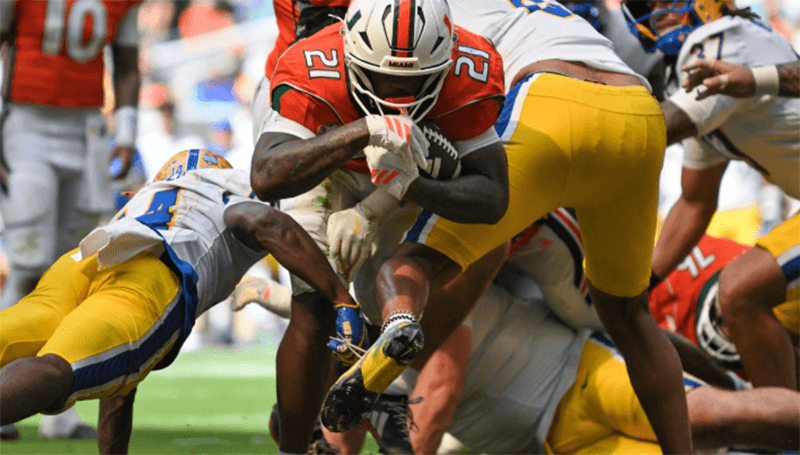
Miami also appeared to recognize that it could create favorable leverage through trips looks and formation variations, then exploit Pitt with quick screens. Once that advantage became clear, Miami kept returning to it. Pitt didn’t execute. Missed tackles and poor pursuit angles resulted in easy touchdowns.
But it keep coming back to the quarterback situation, because I know how quickly uncertainty can turn into internal pressure for a young player.
In 1997, I lost my starting spot to a true freshman. Deservedly so. I played like crap against Penn State at Happy Valley. The following week of practice was some of the hardest football I’ve ever experienced. Every dropped pass, missed assignment, and wrong read felt like another piece of the coaches’ confidence in me was eroding. Like a coastline battered by high tide.
Whether their trust was actually eroding with every mistake almost didn’t matter. That’s how I processed it internally. The pressure I put on myself to perform was enormous. And internal pressure can be a blessing or a burden. It can create diamonds or burst pipes. Fortunately, I responded and finished the season with a receiving touchdown record for both the Big East and the University.
That experience shapes how I watch Holden. I understand the urgency to win, and I understand that opportunities have to be earned. I also understand what it feels like to take the field believing every mistake might cost you the next opportunity.
I saw enough against Miami to want to see more of him. Give him meaningful reps, build on the rhythm he found, and help him turn recognition into anticipation. Confidence grows when preparation meets opportunity, and a player knows he has room to grow.
Terry Murphy is a former Pitt Panther WR, football coach and guest contributor to DreamBackfield since October 2026.