

Penn State at Fault for Keystone Classic not being Renewed
We’re all of course looking forward to the big rivalry game with our friends from Happy Valley this weekend. And yes, as much as some of those friends may refuse to admit it, it is a rivalry. Having the Panthers and Nittany Lions play again the last few years after a decade and a half hiatus has been great for college football in the Keystone State. The first matchup in 2016 was of course a raucous affair at Heinz Field that resulted in a dramatic Pitt win. The game had ramifications stretching the rest of the season as Penn State went on a surprise run to win the Big Ten Championship Game, but were locked out of the College Football Playoff, likely due to their loss that September afternoon on the North Shore. Penn State got revenge the next year when the Panthers went to Happy Valley, dominating from the get-go despite Pitt keeping it close into the second half. Though the current series is currently knotted at only one game apiece, it’s already halfway over. When Athletic Director Heather Lyke took over at Pitt in 2017 she quickly opened a dialogue with Sandy Barbour, her counterpart at Penn State, about scheduling more games between the two schools. This culminated in Pitt presenting a formal proposal to Penn State about a new 4-game series beginning in 2026 this past April. Lyke stated though, that Pitt wouldn’t wait on a response from Penn State indefinitely. This proved to very much be the case when Pitt scheduled a home-and-home with Wisconsin for 2026 and 2027 in late May. This was likely worked out in response to Barbour announcing that they weren’t looking at putting Pitt back on their football schedule until after 2030, despite the fact that it could have easily fit in the late 2020’s. This brings up the main point, though there are legitimate challenges in trying to fit Pitt on their schedule, the imminent end of the current series and the fact that no future games are scheduled is Penn State’s fault.
Penn State does have more obstacles when it comes to non-conference scheduling than Pitt, due to the differing conference schedules. As mentioned above, Pitt plays only 8 conference games as a member of the ACC. This makes it easier for them to schedule more marquee non-conference opponents while hitting the 7 home games that Power 5 teams aim for every year. Basically, this means Pitt can schedule home-and-homes with 2 separate Power 5 teams simultaneously, staggering them so one is played at home while the other is away, and hit the desired number of home games by scheduling two “buy games” against lower level teams. This exact formula was the one Pitt followed in the last two years though it backfired with Pitt going 1-3 in those games. Maybe it’s for this reason that Pitt appears to be backing away from this model, with 2022 being the next year that they have two Power 5 opponents on the schedule in one season. Even that year they play both of these opponents, West Virginia and Tennessee, in Pittsburgh. Regardless, the point remains that Pitt has much more scheduling flexibility than Penn State, though having Notre Dame on the schedule 8 times in the next 18 years throws in a wrench from time to time. In contrast to Pitt, Penn State has a 9-game conference schedule that gives them much less flexibility when it comes to scheduling non-conference opponents. Additionally, the odd number of conference games means that every other season Penn State has 4 home games and 5 away games in Big Ten play. Because of this, in those seasons, Penn State needs to play their entire non-conference slate at home in order to hit 7 home games. For Penn State, those are odd years, which is why in the current series, Pitt goes to Happy Valley those seasons. This means Penn State’s scheduling philosophy has been to only schedule one Power 5 team in non-conference play per season and set the games up so that they play said game on the road in even years. The other two games every season would be “buy games” against non-Power 5 teams giving them 10 total Power 5 teams on their schedule, with 5 each home and away. It would lay out like this:
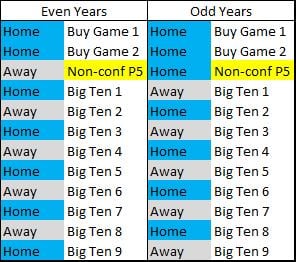
Comments that Sandy Barbour has made in the past are in line with this philosophy. In 2016, after Penn State missed out on making the College Football Playoff that year, she said, “I still believe that you’ve got to [schedule tough games], and it’s been proven out in other places. It was proven out with Ohio State getting in, so it has gone both ways. We’re going to stick with our philosophy from a non-conference standpoint of one Power 5 [opponent].” Fitting in with this philosophy, after Pitt falls off of their schedule after next season, the Nittany Lions play Auburn, Virginia Tech, and West Virginia once each home and away until 2025.
Given these restrictions and scheduling desires, it actually makes sense that Penn State would not want to play Pitt every season. If they only have room for one Power 5 game on the schedule, the only way that the rivalry could be played on an annual basis is if Penn State plays Pitt as their only other non-conference Power 5 opponent every season. As Barbour said earlier this year:
“I certainly have great respect for the [Pitt-Penn State rivalry], but at the same time I also know that it’s important to Penn State fans that we play some of the regional rivals, like a West Virginia or Virginia Tech, which we do have on the schedule, as well as [a] scheduled…home-and-home with Auburn.
Ignoring the fact that Barbour referred to Virginia Tech, a team Penn State has never played before, as a rival, this logic makes sense. The Penn State Athletic Department wants to give their fans an opportunity to see some different teams or travel to some different places for away trips. That’s understandable, but they are playing these 3 different teams over the ensuing 6 years. If Penn State was serious about preserving the rivalry, then they should have accepted Pitt’s proposal to play four games from 2026-2029. Instead, they dragged their feet and claimed they didn’t want to play Pitt until at least the 2030’s, despite not having any other currently scheduled Power 5 opponents during those seasons.
Of course, just because Penn State didn’t have any Power 5 opponents scheduled in the Late 2020’s, didn’t mean they didn’t plan to do so. However, recent developments make that an unlikely prospect now. Just last week, Penn State announced that they had scheduled a home-and-home with Temple of the American Athletic Conference (AAC) starting in 2026 in State College. This means that Penn State will be playing a non-conference game on the road in 2027, a year that they will already be playing 5 conference away games, meaning that they will be playing only 6 home games that season. Additionally, in order for them to play a non-conference Power 5 team in both of those years, as Sandy Barbour has stated is their goal for every season, they will need to play it on the road in 2026 and at home in 2027. This would give them a line-up for those years as such:
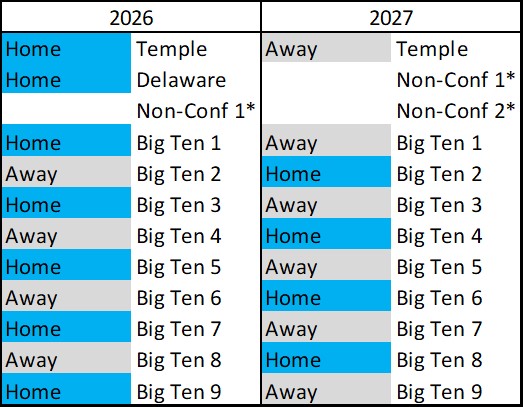
*Currently Unscheduled
Penn State could schedule a Power 5 opponent as a home-and-home in this block by playing them away in 2026 and home in 2027. They could also get more creative with scheduling by not playing the same Power 5 team in back-to-back years. Regardless of how they fill their schedule, they’re going to be left with only 6 home games in 2027 though. Additionally, it doesn’t make sense for them to schedule this series with Temple before having something set up with another Power 5 school. The elephant in the room however, as mentioned above, is that Penn State had the opportunity to sign the agreement Pitt had given them and have a Power 5 opponent during these seasons. Instead they spurned their long-time rival who went and scheduled another Big Ten team during those years. Penn State does get a game in Philadelphia where, like Pittsburgh, they have a huge number of alumni. They also have something of a rivalry with Temple, having played the other Pennsylvania FBS team 45 times. However, Penn State dominates that series 40-1-4, so one could hardly call that a rivalry of the caliber of Pitt-Penn State in terms of competitiveness and passion.
So why did Penn State pass over Pitt’s proposal for a series resumption, then go ahead and schedule a home-and-home with Temple, severely hamstringing their ability to schedule a different marquee Power 5 opponent, as their Athletic Director has stated is their intention? I, unsurprisingly, am not privy to the internal discussions made by the Athletic leadership in Happy Valley, but I have a guess. It’s a well-discussed point by now that Pitt beating Penn State in 2016 kept them out of the College Football Playoff. Though Penn State won the Big Ten Championship Game, Ohio State and Washington were selected instead of them. Washington went undefeated against what was perceived to be a weak slate and Ohio State was selected despite not winning the conference, with their only loss coming to the Nittany Lions. After being left out, Penn State leadership probably decided that it was more important to win all of your games than to win most of your games against tougher competition. If you’re a Power 5 team and you go undefeated, you’ll almost certainly make the playoff regardless of who is on the schedule. Supporting this notion is that since the end of the 2016 season Penn State has not scheduled a non-conference game against another Power 5 school. They scheduled their games against Auburn in June 2016 and their matchups against Virginia Tech and West Virginia several years before that. Penn State hasn’t come out and said that they are not going to schedule any more Power 5 non-conference opponents. However, their stringing of Pitt along in scheduling a resumption of the series, not agreeing to any games with other Power 5 teams, and doing a home-and-home with Temple indicates to me that they have a new philosophy that is in contradiction with their Athletic Director’s past comments.
Pitt leadership has at least presented proposals for continuing the series and have expressed an understanding of Penn State’s scheduling limitations relative to Pitt’s. However, Penn State has done little other than pay lip service to keeping the rivalry alive. Though Sandy Barbour has stated that the two schools could play again in the 2030’s, given the evidence presented above, it seems unlikely that we’ll see Penn State schedule too many Power 5 non-conference opponents in the future. It has become obvious that they want to schedule more winnable games in the non-conference slate to make it easier to go undefeated and qualify for the College Football Playoff. While the argument could be made that conference expansion and realignment driven by television money killed this and other rivalries, this hasn’t prevented other non-conference rivalries from continuing. Georgia and Georgia Tech manage to play every year and Iowa and Iowa State also do despite both teams playing a 9-game conference slate. Additionally, Pitt’s other longtime rival West Virginia has shown no such reluctance to put Pitt on their schedule long-term and the two teams in fact have a 4-game series scheduled in the early 2020’s.
Penn State killed this rivalry once and they’ve killed it again. They’ve decided that they’d rather play games that are ostensibly easy wins in the non-conference, which is understandable. However, they continue to pay lip service to playing Pitt in the future and hypocritically claim they want to play other Power 5 teams while scheduling Temple. Meanwhile, they will continue to try to claim they are “Unrivaled” or actually care much more about their Big Ten rivals, despite being at best a third wheel to Ohio State and Michigan. Penn State aspires to make the College Football Playoff and win the National Title, as every team in the country should, but other teams aren’t ending their traditional rivalries in search of the crown. Georgia almost won the title last year and have a good shot at winning it this year, but they haven’t felt the need to play Georgia State instead of Georgia Tech in order to make their path easier. At the end of the day, if you want to win championships, shouldn’t you just beat the teams on your schedule? And if you can’t beat your rival, who you believe to be inferior (whether it’s a fact or not), what makes you think you’re capable of winning the National Championship? These are questions that Penn State needs to ask themselves when considering their scheduling in the future.
*Future schedules courtesy of FBSchedules.com
*Other information courtesy of linked sources
Have your own thoughts on the imminent end of the current series with Penn State? Comment below or on the message board, or reach out to us on twitter @IntoPitt or directly to me @TheJeemTeam